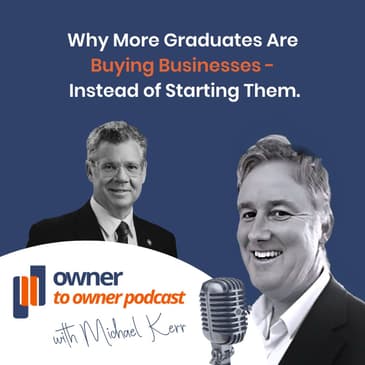
In this episode of the Owner to Owner Podcast, Michael sits down with Bill Lang—Chair of Small Business Australia, Co-chair of Harvard Alumni Entrepreneurs for Oceania, and a seasoned business founder and advisor.
They dive deep into the rising trend of "entrepreneurship through acquisition," exploring why buying an established business is becoming an increasingly popular and less risky alternative to the traditional startup model. Bill shares fascinating insights from his recent Harvard Business School reunion, highlighting the explosive impact of AI on the "solopreneur" movement and how technology is fundamentally lowering the barriers to entry for new business owners.
Beyond trends, Bill delivers practical, hard-earned wisdom for current SME owners. From the critical importance of documenting your business processes and preparing for unexpected succession, to managing cash flow and learning from Other People's Mistakes (OPM), this episode is packed with actionable advice for building and sustaining a successful business.
What You’ll Learn in This Episode:
- Entrepreneurship Through Acquisition: Why buying an existing business is often a smarter, lower-risk strategy than building a startup from scratch.
- The AI Revolution: How artificial intelligence is empowering a new generation of "solopreneurs" to launch fully functional businesses in minutes.
- Succession Planning: Why documenting your business processes is vital for attracting buyers and protecting your family in case of unexpected life events.
- Regional Business Hubs: The essential role of Australia Post Licensed Post Offices (LPOs) in supporting regional and rural small business economies.
- Surviving the Journey: Bill’s golden rules for small business survival, including why "cash is king" and the immense value of learning from other people's failures.
- Policy Reform: Bill's vision for a simplified employment structure and tax incentives to fuel a small business revolution in Australia.
Chapters:
01:20 The Evolution of Entrepreneurship
06:24 Changing Perspectives on Business Ownership
11:34 The Rise of Solopreneurs and AI
16:29 Navigating the Landscape of Business Acquisition
21:36 Preparing for the Unexpected in Business
26:36 Lessons from Past Acquisitions
26:58 The Impact of Capital on Startups
30:04 Navigating Tax Changes and Business Opportunities
32:02 The Future of AI in Business
34:54 Leveraging AI for Small Business Growth
38:43 Aussie Post's Role in Supporting Small Businesses
42:23 Lessons from a Small Business Journey
46:52 The Need for Practical Experience in Politics
#SmallBusiness #Entrepreneurship #BusinessAcquisition #Solopreneur #SmallBusinessAustralia #BusinessAdvice #AIforBusiness #SuccessionPlanning #BusinessStrategy #PodcastSEO
Small Business Australia: Connect with Bill Lang and find resources to support your business journey at smallbusinessaustralia.org.
Thanks for listening. Visit the Owner To Owner Podcast website to subscribe, listen back, or check out any resources or information mentioned on the show.
Search @ownertoownerpodcast on your favourite podcast player to subscribe and listen to the episodes.
Reach out to Michael Kerr via the website if you need personal assistance or advice for your small business.
michael.kerr@kerrcapital.com.au
www.ownertoownerpodcast.com.au
Connect with us:
Website: ownertoownerpodcast.com.au
LinkedIn: Connect with Michael Kerr
Share Your Story: Want to be a guest? Apply here.
Disclaimer: The information shared on this podcast is for educational and general information purposes only and does not constitute financial, legal, or professional advice.
[00:00:07] Welcome to the Owner To Owner Podcast. I'm Michael Kerr, your host, and I'm also the founder of Kerr Capital, where for 22 years now I've worked alongside business owners. Owner To Owner is a business podcast to empower the owners of Australia's small and medium enterprises. Forget the slick stories of tech titans and unicorns. At Owner To Owner we get raw and we get real. Every Owner To Owner episode is a personal conversation with another business owner just like you.
[00:00:37] We explore the everyday struggles they face and the different pathways they tread to success. Practical advice and plenty of one percenters for better returns, less stress, and more enjoyment. You'll find grit, laughs, maybe a few tears, and some hard-won lessons only available from others who've been where you are, whatever your stage of ownership.
[00:01:01] Every owner has a compelling story to share. So join us to listen and to learn. Welcome in to the Owner To Owner Podcast, Bill Lang. Fabulous to have you back in the studios chatting small business. Great to see you.
[00:01:28] Yeah, g'day Mike. Always great to catch up mate and looking forward to having a good chat. We're going to chat about entrepreneurship through acquisition with your Harvard connection, but more broadly that whole movement of entrepreneurs buying established businesses. If we get time to chat about some work you're doing, Australia Post regional small businesses through a stakeholder council. So absolutely core topics for Owner To Owner and building and sustaining our SME economy.
[00:01:59] Bill is the chair of Small Business Australia, the chair of the International Rehabilitation Institute, which is a China-Australia business. Co-chair Harvard alum entrepreneurs for Oceana, co-chair Ausglobal Ventures, co-founder Frownline Shiringa, and Dr. Dog. So you come from a small business background, but you've run, started, sold, founded small businesses and work with a lot of small business owners.
[00:02:26] So welcome again and thanks for taking time to come on. Yeah, look, it's a pleasure, Mike. And I think you should add in there, pretty much made every mistake you could make, sadly in some cases a few times over. But there's been a few wins, but been a lot of losses as well. But, you know, so far it's been a great journey. Nothing more exhilarating than, you know, working with private business owners, people with a get up and go to have a go. Yeah, good. Thanks, Bill.
[00:02:52] The bittersweet of being involved in a small business doesn't go so well. The flip side of that is when you're advising, counselling, mentoring other small business owners, you can do it with a bit more credibility, a bit more gut feel for what they're going through.
[00:03:09] But let's get to, in your capacity as co-chair of the Oceana Harvard Alumni Club, you said something to me recently about the numbers of recent graduates choosing, buying an established business.
[00:03:29] I think when you graduated more than 30 years ago, there was a pathway to strategy consulting, investment banking, you know, the cream of the cream of jobs you could take. So what's happening now and why is it different to back when you were there? Yeah, look, Mike, I just got back from my 35th reunion of graduating from my MBA program. And of the 800 of us, there's about 700 still alive and more than 350 of us turned up in Boston for like three days of get togethers.
[00:03:59] We actually have lectures and classes and, you know, the business school academics share the latest research and news of what's going on. And Harvard Alumni Entrepreneurs is a global network. There's about 22,000 of us that are involved in all the various elements of starting, building, owning, managing, investing, advising, you know, private business owners and entrepreneurs. So I get a good opportunity to get the latest, you know, from Harvard itself and then also in terms of what's going on in our global network.
[00:04:28] When I was there and there were a couple of subjects that had the word entrepreneurial in them, one was called entrepreneurial management, one was called entrepreneurial finance. They had a very particular sort of definition back then of what an entrepreneur was. And the way that professors define it, they said, look, an entrepreneur is someone who relentlessly pursues an opportunity without the required resources. And they said that people that have got resources normally working in big companies or big organizations, they're not relentlessly pursuing an opportunity. They've got plenty of resources.
[00:04:58] For them, they're looking to how they allocate those resources, which things will we go after, et cetera. So compared to back then when, you know, more than half of the class wanted to go and work, as you say, in management consulting or investment banking or big companies in areas like brand management and stuff. And very few had an interest in small business or entrepreneurship. Apparently today, you know, nine in 10 of the current students, they're typically aged between about 25 and 29.
[00:05:26] Nine in 10 now are seeing themselves as future entrepreneurs. They're much more interested in having their own things, starting their own thing. And so the university itself is doing a whole bunch of stuff to improve not only their knowledge and getting them some basic experience in doing that, but even innovating in its own right. They've just launched something called the Foundry. And, you know, in sort of iron and steel making foundries, you know, pump out multiple copies of particular products.
[00:05:53] Well, the Foundry has been funded by a big donation from the founder of Intuit, or the original QuickBooks, a guy called Scott Cook. And he said to the university a couple of years ago, look, there's still so much friction. It's still so complicated to go through the process of starting something. So the Foundry has been built using a whole bunch of AI where literally, you know, you can start testing an idea five minutes after you've had it in the real market. So pretty amazing stuff.
[00:06:19] But the kids are seeing and using AI in everything that they're doing. And those that are their own business are increasingly saying, well, look, one strategy is entrepreneurship through search, looking for a company or a business to buy and or invest in. And becoming the masters of their own destiny through that as a strategy. That did not even exist as a piece of terminology, you know, decades ago. There's a couple of things there.
[00:06:45] It sounds like the sustained university and institution is adapting as well. Partly maybe driven by entrepreneurial grads who are saying, come on, we, you know, we're going to keep up. By doing your own thing, you're talking about both finding and buying an established business as well as starting up a new business. They're the two. Absolutely, Mike.
[00:07:07] And it's not just people that do a startup where they've got an idea for a new product or a new service that they think has, you know, significant growth potential. So we hear all these words like minimum viable product and pivoting and finding product market fit and scaling up and startups and scale ups. So that's the traditional sort of definition of a startup. But it's much less risky to buy an existing business. And then to depending on the goals that you've got with that business.
[00:07:34] And in some cases, it's like, no, you want to have a good business with good predictable cash flow, maybe implement a few different things that might make it more profitable, maybe make it a bit bigger. Or, you know, no, we want to buy it, really learn how to operate it, you know, implement a lot of new technologies and then use the fact that we're running ours well to go and get others that could leverage what we've got in terms of our infrastructure.
[00:07:56] And, you know, the terminology is rolling up existing businesses where you go and buy it from the owner who's looking to retire, doesn't have a whole group of buyers banging down their door to buy it. So maybe you can buy it for two or three times the revenue that it's generating, or maybe even the profit that it generates. But you put it onto your infrastructure and platform. You're growing fast and down the track after you've bought, you know, half a dozen of these. You sell it either into the public markets as a boat or to a larger company, because you've done all the work of putting it all together.
[00:08:27] But now you sell it for, you know, 10 times the profit that the overall group is generating. A great way to, you know, generate a lot of economic and financial value if that's what's floating your boat. But that doesn't float the boat of every, you know, potential acquirer. There are other people that, you know, again, want a predictable income, want to be the boss. As one of my mentors said to me a long time ago, he's an American, and he said that when you think about Eskimos and their huskies, you know, pulling the sled through the snow.
[00:08:54] He said, Bill, you know, if you ain't the lead dog, the view never changes. And so there's a bunch of people that they want to be their lead dog. Is that reflective of different kinds of graduates going in? Or is it just deep down, there's a generation or two of people just want to do their own thing and be their own boss and not have to wait around for a big corporate to decide when that might happen for them?
[00:09:21] We've got a million small businesses in Australia that use Stripe as the online payments platform. Founders of Stripe was in Sydney last week, and he was with one of the founders of Canva, which some of your listeners are probably using or having staff using it in terms of doing their digital design and marketing and everything. And one of the interesting things that Stripe was sharing with us at this conference last week was since AI, since ChatGPT in particular has been made available, there's now been an explosion in what they call the solopreneur.
[00:09:51] So the one person startup. And Stripe demoed on stage literally in five minutes. If you're a Stripe user, you can create your own business and have a website and be taking payments. Like from having an idea five minutes later, and you remember what was involved 40 years ago when we started Dr. Dog versus another business I'm involved with that's recently started and what was involved in getting the presence out there. So now the barriers to converting an idea into a business are just so much lower.
[00:10:20] And amongst the younger generation that are incredibly digitally literate on their smartphones, they may not be that business literate, but it's pretty damn easy to give something a go compared to what it took many years ago. But I still think there's a group of people at the end of the day, if they've had the experience in some corporates or they've experienced some bad bosses or just poorly run corporations that they find it soul destroying. And they want to go and pursue stuff that they're into.
[00:10:45] And, you know, many owners are, as Michael Gerber from the E-Myth would say, there's three types of psychologies of owners. He'd say, look, there's the owners that love their product or their art or their craft more than making money. And somehow or another, they've made a living and they motor along. And there's another group that leave the corporate world. They've learned a lot about managing processes and people, but they want to have their own thing. And often they'll end up in things like franchise systems where a lot of stuff gets provided.
[00:11:13] Then the third group, you know, the way Gerber described them, they're the entrepreneurs. And he defined the entrepreneur as they typically talk fast and they talk about the opportunity and growing big and blah. So there's different personalities and mindsets. And if I take Australia at the moment, the back of the envelope in chatting to Ross Cameron from the Cameron Research Group is, you know, 50 or 60% of our owners just love the product or service, the craft. Five that are managers.
[00:11:39] And then there are, you know, 10 to 15% that, you know, they're going for growth. They want to build something big. They want to make some big impact, make some big money. Yeah. Yeah. Ross Cameron does, you know, really gritty research. I look forward to getting there every month. He interviews real business owners and they share their heart and talk about the stuff that's really going on. It's an excellent resource.
[00:12:05] And I'd say, Mike, one of the things about Ross's work for your listeners is he's been going back and talking to the same business owners every three to six months now for more than 15 years. So he has been, and I know with some of, you know, the clients that you mentor and some of the cases, some that I've been mentoring and coaching now for, you know, 15, 20 years. Yeah. He's seen the journey. He's seen everything. A real practical sense of what it takes. And he, he himself's a solopreneur.
[00:12:32] He's been building up and running that business with just one employee, you know, lots of subcontractors from time to time and suppliers, but it's a one man show. Yeah. Yeah. And it's a bit like a seven up, isn't it? Like going back to the same people, that great British series from years ago. And, you know, so that you, you can tap into the, the changes as well as what's going on, you know, right at that time.
[00:12:57] So this, this move to buying or starting a business, we, do you see that going on more broadly? I mean, we, we started talking about your direct experience with Harvard alums and no doubt that sets a trend. I think entrepreneurs, entrepreneurship through acquisitions been pretty active in Australia the last few years. Pete Seligman up in Sydney, I had on maybe two years ago and it's, you know, refreshing that there's a, there's a bunch of entrepreneurs,
[00:13:26] aspirant business owners that want to take out the risk of starting something and, and jump right into it. What, what other education and support are you seeing to kind of grease this wheel of, of, you know, more, more small business owners? Yeah, look, I'm not seeing a lot beyond, you know, some, you know, business coaches or succession planners, you know,
[00:13:52] that have got a lot of experience in working with owners or helping owners get ready to sell and be prepared to sell, starting to sort of flip it around. And, you know, going out there and looking to find who's interested in learning how to go and buy and operate and grow a business. So that's, that's an area that is, you know, for that group with a psychology around being a manager. So they've, you know, they've left a larger business. They're ideally looking for something established or they're joining a franchise system and having a new, having an additional outlet or finding something that exists.
[00:14:21] That's a market I think that we're starting to see develop. Of course, sadly, we've always had the shysters as I call them, the sellers of the digital notions, lotions and potions. I'm sure there's no one listening to this that's a real owner, Mike, that's making money in their sleep, which apparently you can do in, you know, just spend some money on this program and you'll make money in your sleep. So unfortunately, there's always been stuff around like that, that end up sucking in people who end up buying. I think, yeah.
[00:14:49] Or one of the other ones is buying a perfectly good business for $0 down. Nothing, nothing down. And I was going to say that the parallel here is with the property spruikers that end up selling people into something off the plan, often doesn't end up getting built, has no land associated with it. So there's no capital appreciation. So there's that, that end, end of the market.
[00:15:10] I think the other thing that's starting to happen is we're starting to see more middle management and I'd call junior executives from big companies thrown on the corporate scrap heap. So as, as a big part of their role has been to coordinate the work of humans and then do reporting and move information up and down an organization. A lot of that is going to disappear. Yeah. It's already starting in a whole bunch of firms. So that's having a couple of impacts.
[00:15:39] People that were in some, some cases, uni graduates that would only, the only use of their hands would be doing typing. So if they're doing brain related information, research analysis type work, the bulk of that is getting automated. And if you're experienced, you don't need to deal with the unpredictable nature of the young human.
[00:15:58] So in the U S we're already seeing a 20% reduction in the classic college graduate market in terms of kids coming out and starting off in, you know, at the, at the ground floor, the grassroots related type work. But the other thing we're going to start to see is more and more of groups of people, you know, getting let go chopped out by these corporates as a bunch of what they did is automated.
[00:16:20] So that group will be an interesting group because they've usually developed great knowledge and skills and capabilities as being effective managers or people leaders in those large organizations. But you know, those roles, there'll be far fewer of them. And then when it comes to what's involved in being a business owner is again, everyone listening here knows what it's like. The unpredictability of it, what crops up, the need to pick yourself up, the stress, the fact you're always thinking about it. There's no IT help desk.
[00:16:49] There's no just, you know, submitting the, you know, like you are, you know, you're, you're the lead dog and the lead dog's got to do everything. So that, that becomes quite challenging, I think, for a number of people that are going to come into this market. And that's why in some cases franchises have been attractive. And that's why for, you know, your listeners, Mike, that are owners, the more they think like they wanted to franchise their business.
[00:17:12] So to think about how they have the processes articulated, documented, and a few things like that, it's going to make it easier for the business to be purchased by those people and more likely to be attractive and potentially get a better purchase price, you know, when you're selling the business. Yeah, there's no question that stuff, you know, makes a lot of sense.
[00:17:33] The challenge is getting owners who are later in their careers and closer to wanting to do something else to take the time and energy to do that. And for smart people, you can, you might get a better deal. There's a lot of those businesses that got good bones. And so anything else you would be saying to those owners, like it makes sense to go and make it more like a repeatable business.
[00:17:57] The more, and you know, the irony, the more you do that, the less pressure you run to actually sell it because you, you know, you could get closer to running an under management. We, at Small Business Australia, we're approached every month by universities around the country wanting to place their undergraduate or even students doing master's degrees into practical internships.
[00:18:19] They're not necessarily straightforward to deal with in terms of dealing with the university directly, but we've certainly helped a bunch of our members take on board what we call digital business cadets that actually came in and learned about the business and documented stuff. You know, as you know, with this wonderful podcast, you've done, you know, a hundred plus episodes of the technology. Now these kids know how to use a bunch of these tools.
[00:18:41] And even as an owner, if you just talk to your computer using the right app, it's going to give you the first draft of an actual manual that explains how we do X, Y, and Z. So there's so much stuff there. So owners, their time and energy, it's nowhere near as difficult as it used to be.
[00:19:00] But then secondly, there's a whole bunch of people in the thousands, in their twenties, looking to get a bit of real life experience in a workplace that could be working on a project, helping put this stuff together for you, as well as do a bit of reverse mentoring and show you how to use some of these things. Yeah. Yeah. No. And potentially identify some, you know, future buyers of the business. But I think that's, it lends itself to that.
[00:19:24] There's a lot of these owners in these businesses who won't ever get to the point of advertising it for sale, but it doesn't mean they're not for sale. And so this approach you can make to these owners, if you make it in the right way, you can get the discussion going about what their plans are. And it might take them a while, but it's where, you know, you build a little sales pipeline of these businesses that you might potentially end up buying.
[00:19:50] And the owners who are prepared to mitigate that perceived risk by perhaps hanging around a little bit longer than they would have ordinarily because the business still relies on them. That's another really practical approach. And that means you've got to, you know, both sides have got to give a little bit. Yeah. And recognize that there's a good, strong business, potential buyer, potential seller, and going to have to work together.
[00:20:14] So we don't, you know, we want to be able to fundamentally be able to do that at a personal level as well as, you know, at the business level. Look, Mike, I think it's, you know, I've only had this come home to me again recently. And, you know, I know you with your business and certainly at Small Business Australia, and we've referred many of our members over to you, some of them in this unfortunate situation that someone gets very ill or they're in an accident.
[00:20:41] And not only are they a long way from being prepared to affect the reasonable sale of the business, but they're going to leave it to the widower or to the widow to have to grapple with. Or secondly, you know, someone else to try and keep it together while they're going through their treatment. Yeah. You know, very good friend of mine and I won't mention who he is, but you know him as well. Like I got a message from him four weeks ago. He's just turned 61.
[00:21:04] I just had a meeting with him a few weeks before that, where we were talking about his business and some services he could make available to many of the members of Small Business Australia. He was driving to a board meeting the day after and then started blacking out, fortunately pulled over on the side of the road. Five weeks later, he's got a stage four terminal brain cancer. Like he's had an operation. A whole bunch of us gathered yesterday. He said, look, I don't, you know, I want to be at my pre-wake.
[00:21:31] It'll be a funeral sometime in the next, you know, six to nine months. But it's another thing that really brought it home to me at a very personal level to make a bit of time to start thinking through a bit of this stuff and getting some of it activated. Because it doesn't have to be that hard and keep putting it off. And as you know, it's the worst case scenario. All of a sudden the owner is not available for work. And I've got to try and convert this thing into potentially something for the people that have been financially depending upon it. So that's the worst case scenario.
[00:21:58] You know, the best case scenario is you're a bit more prepared. You know, you've had many people approach you over the years that have got small private equity funds looking to buy particular types of businesses. So they are out there looking for deal flow. And, you know, you're recommending those that are meeting their criteria.
[00:22:15] So even if you've got a business and you're not actively looking to sell it, making sure that the network of where these people doing a business search strategy are looking around, that you're aware of who they are. A bit like when real estate agents know a property is for sale, but it's not listed. I think that's a really important point you're making. Yeah, it's great intel. And you can go and have an open conversation. You know, be smart about what you share and don't share.
[00:22:44] But those are acquirers and small private equity groups. You learn a lot from them because they're professional acquirers. I guarantee you have that conversation and you'll learn quite a lot. You have a few conversations and you get different perspectives on what buyers are wanting. And it's education. It's motivation to actually keep doing something to make your business easy to sell. And those calls happen a lot.
[00:23:11] For all the hoo-ha about selling a business on a business for sale website, there's still only 10,000, 15,000 businesses listed for sale. What happens is within industries, businesses up the line are watching for the good businesses down the line. And that's where those off-market transactions happen. And they happen all the time. Good, bad or otherwise economic conditions.
[00:23:39] It's why you've got to be ready for being acquired. Remember one of my mentors saying to me a while ago around, somebody said, oh, yeah, you've been very lucky. And I said, there's no question with a couple of businesses, we just happen to be in the right place at the right time. But, you know, I still remember seeing NASDAQ go from 6,000 to 1,200 in one week. And then we had waited too long and we'd made the mistake of picking an investment bank that was going to floaters,
[00:24:07] but not really understanding that they weren't guaranteeing to get us the money. And so they disappeared, you know, after hundreds of thousands of dollars had been spent with law firms and accounting firms to get the prospectus together. And, you know, everything was all set up. So things can change from that perspective, you know, pretty damn quickly. And again, I think we don't know what's around the corner in terms of the things that are uncertain, but certainly focused time and energy and effort is there.
[00:24:36] We can control that. And there are some simple things that every business owner can do to move a step or two to be, you know, better prepared. But the mentor said to me, he said, look, yeah, you've been lucky. And he said, but look, the thing about luck is in some respects, it's the intersection of preparation and opportunity. So you may not know when the opportunity comes, but if you're prepared, you'll see it and you'll be able to act on it and take advantage of that opportunity.
[00:25:02] Now, the other person said to me, yeah, luck, you know, it stands for laboring under correct knowledge, L-U-C-K. And I was with a business owner recently and we were chatting about a few different things. And you're saying, well, look, we've just got to hope, you know, I said, you know, hope is not a strategy, right? Labor under correct knowledge. Have a strategy. Doesn't have to be super sophisticated. Probably the more basic, the better that you can take a few steps, take a few actions, make a bit of progress.
[00:25:30] And if the opportunity turns up, you're going to be much better prepared than what you were. Yeah. Hey, just on that approach and being there and taking the shot and earning the right to have a bit of luck here and there, you did have a couple of acquisitions or businesses that didn't go to plan. Looking back on those, what would you do differently when you do it next?
[00:25:52] Well, one of them was a sort of a human char business and sort of technology business with its own technology that had been built well before what we see is happening now in terms of technology platforms. And as I said, on Stripe, you can get a business started in five minutes. You know, you can get your website going for 30 bucks a month with a bunch of these platforms. Whereas that would have been $100,000 of development expenses over a four or five month period, you know, 15 years ago.
[00:26:18] So with one of the particular businesses that we purchased, we didn't understand enough of the technical due diligence that was required in terms of the new platform that was under development. So that was, we should have totally changed the structure of how we paid for that business and what needed to be delivered. So that was a big mistake. The second thing was really then is actually looking at how people bought the product and service and how it would evolve that the future was going to involve many millions of dollars of capital expenditure
[00:26:47] on system of software upgrades, building of apps, a whole range of different things that this small niche business was never going to be able to do versus significant startups with hundreds of millions of dollars of capital. And with a runway that they're able to lose money for five or six years to establish a strong market position.
[00:27:07] Now, so, you know, some of your listeners again are probably using Xero and have got the rude surprise of Xero all of a sudden deciding that it's worth another 10 or 12% per month of what they were paying. Yeah. So we're going to start seeing this happening with most software as a service type providers that have got us sort of committed and addicted to what they provide. You know, switching time and costs, it's working, I'm not going to do it. You're going to see a lot of that stuff starting to get ratcheted up as well. Yeah.
[00:27:34] Well, in some cases, it's a payback for that business and those investors that have put years and years into, as I say, building and waiting out everybody else. And you feel like it's going to come at some point as a bit of a catch up when you're a consumer or a user. Yep. It's, I've got a service that I use now and it's been the same price for three, four years. And the functionality just keeps getting loaded with new things. And I know it's coming, but you know, that's takes deep pockets, doesn't it?
[00:28:03] To out survive, outrun. Was that a case of looking at getting somebody technical into kind of assess? We should have structured the way we would have paid for it based on then paying for the delivery of the new platform rather than, you know, buying the business and then taking on the process of having to then manage the software provider that was doing the development and all the rest of it. So there was risk on implementation and cost associated with that. I should have, should have just paid less for it. Yeah.
[00:28:32] You know, it was a, there were some other people interested in it. If I had my time again, unless I paid half the price for it and, you know, had these other payments contingent upon the actual delivery of working platforms, I wouldn't have done it. Hi there. Just a short interruption and a message from Kerr Capital. Kerr Capital specialise in advising business owners who want to get sale ready or, as is increasingly common, get approached out of the blue by a potential buyer.
[00:28:59] If this is you, I know there'll be plenty of big questions and a lot of uncertainty. We're expert at supporting owners in making significant personal and business decisions and then helping create a really strong plan of action. If you want to find out more, contact us at the Kerr Capital website and then we can book a 45 minute no obligation discovery call. Now let's head back to the podcast.
[00:29:28] Just more broadly, we, in the last budget, there's been a heavy hit to residential housing as a negative investment, softer market generally. But I did some analysis a while ago of the domination of housing and managed investments in the average Australian's family balance sheet. And equity in businesses, you know, is really nowhere on ABS numbers.
[00:29:56] Is this time and an opportunity to kind of increase the percentage of average family wealth from a business, a small business? We might've had 20 interactions at Small Business Australia in the last couple of months or, you know, from younger people just starting out wanting to know, should they start the business in Australia? So as an example, as opposed to Singapore or Hong Kong. Yeah. Yeah. Different parts of China, Dubai.
[00:30:22] And these were businesses where they're looking at an international audience, largely delivering what they'll deliver over the internet. So they don't need to be based in Australia. So the changes to things like the capital gains tax, the reduction in having small business owner discount, those sorts of things were problematic for them. So I think there's a group that are going, I don't need to be here. I can be somewhere else. So it's going to be, you know, it's going to reduce the financial costs of getting started and potentially increase the returns if we make it, if we pull it off, you know, down the track.
[00:30:52] I was with a very successful client last week who's in the online legal advice space as a legal services membership type platform. And as he was saying, you know, he's watching the other night, the federal budget and then sort of, you know, the penny drops for him and then all of his shareholders. He's got to go and get the company valued. But in terms of, you know, the increase in the valuation of that business versus what they might sell it for down the track, they've just had the Australian government put their hands in their pockets and take more money out. Yeah.
[00:31:22] Yeah. That business must be at a stage where it's quite confident about its future exit. Yeah. Well, interestingly, they've been approached by the leading venture capitalists in the US looking to drag them to the US 18 months ago to launch AI law firms. Now the legal system there is very different and these guys are pursuing their own strategy over there that they'll be announcing soon.
[00:31:43] But, you know, the big investors with big, deep pools of money are looking around and going, who's already got a chunk of what we need here in these innovative new service categories? Because, you know, in many respects, you know, AI and what it is most of our, most people's experience is using ChatGPT or Copilot or they heard about Claude and Claude's the best. So they're using Claude. You know, they're using it for about 5% of what you can use it for.
[00:32:07] It's a bit like when electricity first got invented by Thomas Edison, you know, and he started powering some light bulbs in New York City. Like it took about 30 years before electricity replaced gas lit lighting in New York. So we're at this very early stage of this new technology. The whole infrastructure is getting built.
[00:32:28] Trillions are being invested in building the data center infrastructure, but it's going to make so many things so much faster that the rate of innovation of what takes place, you know, it's, we would never have seen anything like it in our lives. So again, when we're thinking about businesses that we've gotten our plans with them, like, are there a bunch of things that happen now where people interact with people on a repetitive basis? Yeah. Most of that can go. Yeah.
[00:32:55] I saw one in the U S recently where these guys were psychiatrists and psychologists. And for your listeners that have ever watched those shows where there's a psychologist, you know, there's often a tape recording, recording the session. And then the psychologist would listen to it and sort of write up their notes and add to their notes and be forming their, their view of the diagnosis as to what the condition might be, et cetera, et cetera.
[00:33:17] So this particular startup has 30 years of those recordings of the top psychiatrists and psychologists in the U S and the product they're building is that in real time, you know, Bill Lang psychiatrist is with client Mike Kerr patient.
[00:33:31] And we're having a chat and we're having a chat and in real time, it's listening to the words you're using, the tone, the speed, how long you take before you answer the question, all of this sort of stuff to augment and help the psychiatrist have a potentially more accurate diagnosis. And ideally a bit faster than what would happen otherwise. You know, many of us know about 5G technology. Maybe we're on a 5G plan with the mobile.
[00:33:57] Well, uh, in 6G, right, which companies like Huawei and China are already developing 6G will pick up any changes in your physical presence as you move through a space where there are 6G. So it won't just be like the video recognition and doing facial recognition. It's going to pick up, you know, your gates, your stance, the speed at which you're walking.
[00:34:18] And you're seeing a whole range of different stuff that's going to revolutionize any number of types of EG healthcare services that currently rely upon observation and one-on-one. And so look, we, uh, you know, I don't, I don't think it's overhyped. We may well see a few corrections in the valuations, but yeah, people talked about Amazon being overhyped for a long, long, long, long time. And that's trouble. And now for, for the, uh, for a typical SME owner, I mean, all of the, what you say makes a whole lot of sense.
[00:34:46] What would you encourage them to do first, just to get a bit of a run on if beyond just saying, I want to rewrite my email. Even going out and saying, well, look, yeah, what can you tell me about bill hyphen lang.com? Right. Uh, so maybe on this business owners website, there's an about us page that talks a bit about the business, the history of the business. So ask, uh, you know, whichever one you want to use, chat GPT, Grok, uh, co-pilot, ask it what it knows about your business.
[00:35:17] Ask it, uh, you know, I'm looking for service provider X, Y, Z in the following area to help me. Are you even being seen? So a number of owners have, you know, invested a lot of money in getting the website sorted out. Maybe they were doing a bit of blogging at one stage, some social media guru convinced them they should be blogging. And then, and then there's, then it's sort of like, no, I can't see the return on it. So they stopped doing it. Then they got told to have an Instagram account. You name it. This stuff keep coming in waves and waves.
[00:35:44] Increasingly people are asking AI bots things. And if you're not turning up potentially in the answers to whatever those questions are that people are asking, you're, you're not going to be found. By any of those potential customers. See what it thinks about your business, uh, and about you and why people should work with it, why they should choose you.
[00:36:06] And then also, you know, put in a few, a few prompts, ask a few questions of the AI bots about your product or service category in your geographic area. If that's relevant. If convenience, geographic convenience is important to customers and see who comes up and then go and have a look at what they're doing.
[00:36:23] Because it may well be that they're already implementing more of a search everywhere strategy as opposed to an SEO, you know, that might've been really powerful on Google and still is on Google. Yeah. Yeah. And, and, and it's right there for you to actually do that yourself to see what, what results it shows, shows to you. Do it across, you know, four or five of the models and you might well get a big fright or see some opportunities that you didn't see.
[00:36:51] You can ask yourself, well, look, what should I do, you know, to my website? Now ask it the question. Don't go and speak to the guy who builds the website for you. At least be a little bit more informed based on what the bot is suggesting. And again, these bots, you know, share this story. So I'm helping my youngest adult son who's 28. He's got a street basketball competition that he's created called King of the Court. And, uh, you know, he's, he's got his first ever tournament happening in New York in a couple of weeks.
[00:37:17] And so I was interacting with ChatGPT around, you know, we've got a company doing the sponsorship of it. How should we think about X, Y, and Z? And ChatGPT goes, you know, says, well, Bill, in my experience. And I said, hang on a minute. Like what experience do you have? So the first thing is if they have no experience, they are designed to keep you involved in a conversation as long as possible. So, so it'll, it'll start saying that's a great idea, Bill. That's really insightful, Bill. It is sucking up to you. It is sucking up to you.
[00:37:46] So don't, don't get caught into giving it a human's name and starting to think it might be a human. These things are designed to keep you on them as long as possible. In the same way that Facebook and Instagram has been designed that way to keep kids and young adults on them as long as possible. But, but you can use it. You can ask it questions, seek its point of view on suggestions that it makes. And so literally with this thing, then I, you know, it was suggestible, yeah, would you like me to generate them posts that you could use on Instagram and Facebook? And I said, yep.
[00:38:15] And it generated a whole bunch of them there and then. So that stuff's incredibly powerful, but just be careful not to get sucked into thinking that it really knows you and cares about you. Right. Right. It's a, it's a robot. All right. Let's go, um, to Aussie Post. You're a member of a council of stakeholders. Do you just want to explain what, what you're doing with them?
[00:38:43] Yeah, look, the stakeholder council is an initiative that Aussie Post has where people bringing a point of view from different sectors of Australian society. And so, uh, Senator Kay Patterson for many years has been bringing some perspectives of elderly Australians. You know, Kay's in her early eighties. Then there's another gentleman who's representing the disabled people of Australia's association. Someone from the online retailing sector.
[00:39:10] So Australia Post sees a big, big part of its future is everything to do with, with moving, helping retailers get more customers. Uh, and if it involved delivery, delivering those packages, making them available through, through things like parcel lockers, convening and delivery times, a really good app for doing all the tracking and everything, uh, through to easier ways of products getting returned. So for, for small businesses, particularly that are involved in product physically to, to places, that's a very important part of Aussie Post.
[00:39:38] Aussie Post has, I'm going to, I'm going to see if I get the numbers right, about four and a half thousand points of presence. So physical businesses you can walk into. And of those, there's maybe about a thousand are owned by Australia Post and the rest are called LPOs, licensed post offices, which are often, uh, well, they're always small businesses, but sometimes there's other small business services available from that location. Which might be everything from a news agency to stock and station agent in the country.
[00:40:07] Uh, so from our perspective at Small Business Australia, many of those licensed post offices in particular, and the company owned stores are a central, essential service. In terms of what they provide, not only to the general residential community, but, uh, absolutely critical for the small businesses. Particularly when we get out to, uh, remote and rural Australia where, you know, there is no other major presence or brand actually in town.
[00:40:36] So, uh, you know, our role on the stakeholder council is to, um, you know, provide input into the executive team, review some of the ideas, initiatives that they've got. Uh, but just be a sounding board, Mike. Yeah, well, they, they occupy, um, a major part of the local economy in, in these small towns and, um, it's, uh, they generally have a large physical premises and a central position.
[00:41:00] And it's, you know, nice to see that maybe some more development, more usage of the, of the properties and the, and the, and the LPO business can be thought about over time. Well, and I, and I think for your, your listeners, Mike, the, you know, licensed post office operators are small business people. Like everyone listening to your podcast. Yeah. And I would, and if you're in that local area, you know, you know, Bill and Fiona that run that joint. And so I didn't care. Yeah.
[00:41:27] I think there's a lot of opportunities for entrepreneurial activity in a bunch of these areas for the locals to get together and work out what are they value? What do they need? And, and put together the case and whether it's to a, you know, a bank that's franchising community banking, whether it's to the local government representing the, you know, whoever's running the shire. Yeah. Cause at least you can have some direct input to who gets elected onto the shire, whether it's the MPs, state and or federal, you know, get organized, you know, prosecute the case.
[00:41:56] That's the way you end up getting some influence and getting closer to getting what you need. Yeah. Excellent. Well, you know, I just spent the last couple of years in a, in a, in quite a small regional town and along with the news agency, they were real, you know, real hubs. And, um, go to places for a whole range of things other than the obvious, but I suspect there's a lot more you can do with them and they're going to be there for a long time. Interesting projects. You grew up in a small business family.
[00:42:26] Your, your son's starting his own business. What's the one piece of advice you gave him that you think would best sum up what you learned along the way? It's difficult to pick, you know, just, just one. Go for three. Without, without customers that are prepared to pay you more than the cost of you providing the product or service, you don't have a business. And there's nothing wrong with having an ABN number and what, having what I would call a self-employment vehicle, right? You want to be the lead dog.
[00:42:56] You don't want to necessarily be employing a bunch of people, but at least you've got enough, enough customers, enough leads coming in, becoming customers. It'll pay you enough money over and above the costs of what you're doing to live the life that you want to do. You know, one of the things I have been, you know, sort of emphasizing a Mitchell is what people say and what they promise. It's when the money is in the bank account, you've actually got the money.
[00:43:20] You'll recall Mike in our Dr. Dog days when we started to scale up and then we found that sales had really dropped off and we couldn't understand why we weren't seeing it based on the cash coming into the tin. And the stock that was getting returned to us every night, we sat and we watched it and saw it with our own two eyes. And then we walked over and we looked in the back of the van and these couple of guys that we had hired had their own eskies full of their own hot dogs, their own bread rolls. Back then, of course, you know, everything was in cash.
[00:43:50] The business absolutely dies when you run out of cash. If you're having to be raising money, you're always raising money. You're never not looking to raise more money into the venture. But I think for all of us, we, you know, we appreciate that at the end of the day, you know, we're looking at the takings, we're looking at what's going on, what's going out. And that's what's made, you know, the current years, you know, recent years since the management of COVID by our various governments, you know, particularly troubling around then inflation, supply chain, costs of everything.
[00:44:19] Every input into our business has been going up. And that's, that's very rare in the, you know, financial economic experience, you know, in my time that, you know, that I've been involved in, in small businesses. So, you know, we know that it's all about cash, Mike. And even if you take now via Bluetooth payments, even these days, we wouldn't have that these days. We'd be able to use Bluetooth, but these guys might have the app on their own phone and be taking the payments directly to their own phone.
[00:44:46] But rich, rich, rich business lessons to be learned just by having a crack and making some mistakes. I know you're a huge advocate for reading and accessing mentors because what might happen to you has happened many, many times to many, many others. And you can learn from that. That's something I always took away from you. There's, you know, ferocious capacity to read and listen and watch and learn.
[00:45:13] So, but get out there and have a crack and build your own little set of pains, you know, pain points that you can learn from. I think you've raised a really, really important thing there, Mike. And I still remember our first night with Dr. Dog and we had 300 puppies on board and only sold, only moved five. Three of us all had one each and then we sold two. And that's because we put it in the wrong location, the van and the batteries went flat and none of the lighting worked.
[00:45:42] But the next night we got on the right location across the road, we had the backup battery and we sold out in two hours. Now, many people say, look, you know, the best way to learn is to learn through experience. And I say not necessarily. If the consequences of making a mistake are small, absolutely. But the best way to learn is from other people's mistakes. There's no, there's no guarantees to success. And I define success as of achieving the objectives, the goals that you had when you set out.
[00:46:07] But there are absolutely repeated causes of failure over and over and over and over again. So OPM, other people's mistakes. That would be, that's my number one, Mike. Two to finish, Bill. The idea of compulsory small business service for pollies and advocates in small business came up on a recent discussion.
[00:46:26] I reckon that's anything in that for a few days or a year where small business does employ a significant number of people. And a lot of those, the owners of those businesses need mentoring and they need advice and they need to change things. But would it help if some of these people who'd never been in a small business spent a bit of time in one?
[00:46:52] It would help, Mike, if it's aligned with the incentives and what do people want to achieve and move towards? What do they want to avoid taking place? Now, we could put a bunch of these politicians in small businesses for a month. But unless it impacts their ability to get elected in a serious way, as opposed to their goals as a politician, which might be promotion in their party, one day being a minister, whatever it might be. Unless it directly contributes to their goals, we'd be wasting our time.
[00:47:20] You know, they'd be going to McHappy Day and selling a few hamburgers when Ronald McDonald makes them available for 50 cents or whatever they do. What would be much better, I think, Mike, is making sure that you couldn't actually ever nominate to be a politician unless you could demonstrate some actual experience. You had some performance appraisals or reviews, but, you know, and then you had clear things that you were committed to that you were going to do no matter which political party you were in once you were in. You think about how crazy it is.
[00:47:49] Some people join these parties and they get elected, then they leave the party. They got them elected and they become an independent. It's like, well, hang on, that's not what people voted for. So, look, the system and the incentives, I think, are the most critical thing. Yeah. I know you and I have been chatting around, hey, geez, if you were the boss of Australia for a day, you know, what would you do to help encourage and fuel a small business revolution? You know, for me, it's the first thing would be we need a really simplified employment structure.
[00:48:16] One award, one hourly rate for anyone that works in a small business, you know, up to 20 employees. Really simple rather than all this complexity, all the money the lawyers, the HR advisors get. Let's reduce the complexity. I think we need to make sure that in school, you know, every kid is having to do a bit of a business plan when they're in year nine or year 10. And they're learning basics of financial literacy about interest rates and borrowing money and saving and expenses and that they learn what profit is.
[00:48:45] And in my world, as I know it is in yours, Mike, we say, look, rather than like, you know, I think Skyhook used to say, ego is not a dirty word. Well, you know, profit is not a dirty word. You know, I look at profit as people realizing opportunities for improving tomorrow. So, so we need to brace this mindset rather than thinking all these business owners are rich, rich, rich people driving around in Rolls Royces and screwing over the employees and the workers. It's the biggest load of bullshit that's out there.
[00:49:12] We need people from a young age understanding what makes a market economy, political society go around. Look, and the last thing is I'd be getting rid of any capital gains on any increase in the value of a small business. So capital gains discount was a positive move years ago. But you want to take away the incentive from the pie makers, the pie creators. There ends up being no one to make the pie while a bunch of people are just carving it up and wanting to eat the pie.
[00:49:38] So we have to bring back the incentive for the creators, the builders, the makers to make the pies of the future. Yeah. Excellent. Bill Lang, you're a champ. Lots to take in there. Thanks so much for your time. Very much appreciate that. And I know you're off on another adventure shortly. Travel well. And I'll afford to catching up another time. Great to see you, Mike. Yeah. All right, Bill. If someone wanted to reach out, they can find you on LinkedIn, I'm guessing. Yeah, easily.
[00:50:06] Or just make contact via the smallbusinessaustralia.org website. Okay. All right. Thank you, Bill. Thanks, Mike. So thank you very much for listening. I hope you enjoyed this episode of Owner to Owner and got some helpful advice and maybe some more clarity on how to make your business work better for you.
[00:50:32] To subscribe or to listen back or to access any of the resources or information we talked about in this episode, head over to the website, owner2ownerpodcast.com.au or you can search up Owner to Owner Podcast on your favorite pod player. If this episode or the podcast generally is really helpful, I'd love it if you could leave me a like, a rating or review. But even more than that, I'd love it if you could share it with another business owner.
[00:51:02] There's a new episode out every couple of weeks. I'll catch you then. Bye. Bye. Bye. Bye.