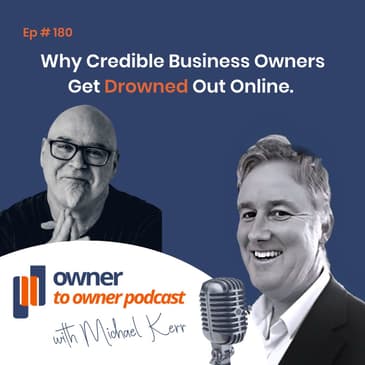
Why every business owner needs to build authority.
Michael sits down with Trevor Young—PR and communications advisor, coach, mentor, writer, author, and podcast host—to unpack why building authority is a strategic business asset for SME owners.
They discuss how founders can build credibility, visibility, and trust without falling into noisy self-promotion. The conversation also gets practical about content, earned media, owned media, and how all of this affects growth, reputation, and even business saleability.
In this episode:
The real job of PR: Trevor reframes PR as building a deeper connection, trust, and reputation with the people who matter most to a business, rather than just chasing press hits.
Why good owners stay invisible: A look at tall poppy syndrome, analogue mindsets, the fear of bragging, and the discomfort many owners feel about putting themselves out there.
Content-led communications: Trevor breaks content down into four distinct buckets:
- Utility content
- Thought leadership content
- Personal content
- Brand content
Why owned media matters: The case for email newsletters, websites, podcasts, and other channels you control, rather than relying solely on platforms that can change their rules overnight.
Pick fewer channels and do them well: Why you shouldn't try to be everywhere, and how to build a strong base on just one or two channels (usually LinkedIn plus an owned channel).
Matching format to founder: How video, writing, and audio all have a role, and why the best format depends on the founder’s strengths, the audience, and the business model.
Thought leadership > generic utility: While answering common questions is useful, the stronger opportunity is to express a point of view and challenge the status quo.
Trust takes repetition: Why people often need to see you 7 to 12 times before they factor you into their thinking.
Authority helps sales and exits: How personal brand, business brand, and strategic communications affect acquisition, talent attraction, and the ability to build a business that can run without the founder.
Timestamps
00:00 - Why business owners need to build authority
00:58 - Trevor’s background in journalism and PR
02:12 - Why he works with credible founders and experts
05:31 - Tall poppy syndrome and the fear of visibility
07:25 - Why content paralysis happens in a noisy media landscape
09:24 - Why owners already know they need to act
11:45 - Content-led communications across owned, earned, and paid media
13:27 - PR versus marketing and why the distinction matters
16:22 - Choosing the right content format: writing, video, audio, visual
17:42 - A property company’s 350 video and live stream playbook
19:10 - Why owned media beats platform dependence
21:14 - Personal brand websites, books, and digital ownership
22:52 - The reality of omnipresence and big creator teams
24:42 - Why most business owners should focus on fewer channels
27:05 - Utility content versus thought leadership
28:30 - Why a contrarian point of view can matter more than FAQs
31:27 - How repeated exposure and personal stories build trust
34:19 - The four content buckets, including brand content
35:22 - The 80/20 rule for promotion versus value
39:42 - Why newsletters still matter, even if they are simple or curated
41:20 - Why YouTube is a major opportunity for business owners
42:42 - Building a show instead of random videos
45:57 - Beehiiv and newsletters as business assets
49:49 - Why human stories beat AI and how earned media helps discovery
51:34 - How AI tools use earned media and websites to verify people
55:38 - Why companies should make internal people into stars
57:06 - Michael Hyatt’s move from personal brand to business brand
62:49 - Using back channels and case studies to support sale readiness
64:42 - Creating heat around a brand through visibility and speaking
67:19 - Talent attraction, retention, and employer brand
68:42 - Adam Robinson’s LinkedIn growth and startup content strategy
71:41 - What Trevor would do if asked to lead small business policy
74:09 - Where to find Trevor’s website and newsletter
Notable quotes
- “We want to hear from the genuine people who have got something to offer.”
- “If you just do rollout paid ads and you have nothing underneath to back it up, you're gonna have to put your hand in your pocket for a lot longer.”
- “If you want to grow quickly from a low base, it's all personal brand. If you want to build to sell, it's the business brand first.”
Thanks for listening. Visit the Owner To Owner Podcast website to subscribe, listen back, or check out any resources or information mentioned on the show.
Search @ownertoownerpodcast on your favourite podcast player to subscribe and listen to the episodes.
Reach out to Michael Kerr via the website if you need personal assistance or advice for your small business.
michael.kerr@kerrcapital.com.au
www.ownertoownerpodcast.com.au
Connect with us:
Website: ownertoownerpodcast.com.au
LinkedIn: Connect with Michael Kerr
Share Your Story: Want to be a guest? Apply here.
Disclaimer: The information shared on this podcast is for educational and general information purposes only and does not constitute financial, legal, or professional advice.
Transcript:
Building Authority and Credibility in a Noisy World
00:01:20 | Michael: Why every business owner needs to build authority. Today I'm chatting to Trevor Young, PR warrior, coach and mentor, writer, author, podcast host and guest. Trevor, it's great to have you into the Owner To Owner Podcast.
00:01:20 | Trevor: Thank you very much for having me, Michael. Look forward to our chat.
00:01:37 | Michael: We're going to explore something that is dear to my heart, SMA owners, and why and how some of them can capitalize on this opportunity to really build some credibility and visibility for themselves as the owner founder of a business.
00:01:55 | Michael: And why it's really a strategic business asset, not just a marketing exercise that you can apply to the business while you're growing it and potentially, and interestingly, when you start to think about selling it. So you've been 30 years helping owners to earn recognition. How do you do that? And why do you do that, Trevor?
00:02:21 | Trevor: How do I do it? Well, that changes from year to year with all the technology changes we've had. But certainly why I do it, I started as a journalist. So my background is media from my early, early days. And from there, I, in the country. And then I came down to the city, the big smoke of Melbourne and joined a PR firm and then just went around different PR firms. And then one day I thought I could do better myself. So I got together with a former colleague and we built a quite a big agency, actually a couple of agencies and sold those to a publicly listed company.
00:02:50 | Trevor: And then I set up a new one, another boutique one and merged that with the world's biggest PR firm. And I've also been very heavy in the content space and trying to work out social media and content from a PR perspective and helping my clients grapple with new ways of communicating with an audience that's changing rapidly.
The Challenge of Cutting Through the Noise
00:03:12 | Trevor: And what that looks like. And why I do what I do now, Michael, really is I find, I work with credible people and have done for quite some years now. I mean, early days when you're, you know, when you're in a PR firm, you're told what to do when you're running your own. You know, you're, you're working with a vast array of different organizations and companies and brands. But these days I'm a solopreneur and I can pick and choose who I work with.
00:03:38 | Trevor: And my whole reason for being in more recent years has been, there are so many great people, credible operators. You know, they might be professional experts or a practice leader within another organization, or more likely they're, they're a founder entrepreneur or they're a solo practice owner also.
00:03:55 | Trevor: And they're getting drowned out. And they're the ones we want to hear from. We want, we're at a period of time where there's so much crap coming out of us from every digital channel, no demand. And then some, but the noisy ones are the ones that are, you know, we're listening to and having to be forced, you know, they're cutting through the noise.
00:04:17 | Trevor: They're not the ones we want to hear from. We want to hear from the genuine people who have got something to offer, who can educate us, inform us, change the way we think about a topic or issue. And I've found that then people that have been in the game for a lot longer, of course, they've got the runs on the board, scars on the knuckle to prove it, but they're the least likely ones to put themselves out there.
00:04:36 | Trevor: And that frustrates me in equal measure. But it also means that, you know, when I do, when I see someone who's doing it, or when I can help someone, you know, gain clarity and confidence in terms of their knowledge, their expertise and their wisdom, and to get them out there, creating a profile and a reputation that, and that leads to other opportunities for them. I get a really good buzz out of that because the key thing is, again, we want to hear from the good people.
00:05:04 | Trevor: We don't want to hear from the opportunists and the hucksters and the wannabes and the people who might present themselves really persuasively online and look really good. But if you scratch beneath the surface, there's nothing there. But on the flip side, you get the people who are great and credible and got a lot to offer, and we're not hearing from them. And that's frustrating.
00:05:24 | Michael: And that's a great why for you, isn't it, to support those people that are an alternative and are based on lots of pedigree and provenance, which is something you talked about in a recent article, and years and years of experience. So why is it that those owners aren't being hurt? The odds are against them. Is it easier to be highly visible without any authority? What's going on there?
00:05:53 | Trevor: Let's unpack it. There's a couple of reasons. I mean, one is, you know, the people we speak of, chances are they've grown up analog, for starters. In Australia, you know, you don't want to put yourself out there, tall poppy syndrome. You know, a lot of us have gone through that. I mean, for my mind, I've got to go through that myself. I mean, I was always the one behind the scenes pulling the strings. And then one day I've, you know, I'm out in front. But it, and it's something that you've got to get used to.
00:06:17 | Trevor: And for a lot of people, A, they don't want to do it anyway, because there is that long held belief that you don't put yourself out there because it's, it's bragging or it's, you know, whatever you say it. We don't want to see ourselves as overly promotional. So there's that. But the other side of it is that they see what's going on around them and they see people who are very visible and they're, you know, I'm going to be being facetious here, but dancing on TikTok. You know, they're doing stuff to get noticed, to gain attention.
00:06:46 | Trevor: They're loud, you know, and they don't like it. And they equate visibility with those people, the ones that are, you know, they'll punish you with emails if you sign up with them. And, you know, they'll, they'll use every trick in the book to gain the algorithm. And, you know, we see them every day on LinkedIn and Instagram. And if you unfortunately sign up to something on fire email with them, you'll get punished on email, you know, and we see that and we don't like it.
00:07:15 | Trevor: And so that's has an effect anyway. And they're both mindsets which need to shift. So you need to shift those two. Then comes just the sheer challenge of it. The sheer challenge of it's never been noisier. We get our news and information from, you know, so many places now. We don't just sit there and watch the six o'clock news, if at all now.
00:07:36 | Trevor: You know, we get our news and information from a variety of sources, from podcasts to Substacks to Instagram to LinkedIn to, you know, maybe the nightly news on, you know, the ABC. And it's a mix. But we can't take our news and information from everywhere. So our people's, the people we want to deal with, their attention is splintered greatly and it's getting more so. Plus the fact people are distrusting our audience. The people we want to reach, they're so cynical and distrusting now.
00:08:05 | Trevor: So you've got all of these issues that one is a mindset and held beliefs. The other is the landscape that which we operate. And people look at it and they say, I just don't know what to do. Often it is simple as I don't know what to do because it's, you know, I've got this person telling me I've got to be on YouTube. This person telling me I've got to be on LinkedIn and this is how to do it. But there's so much noise and people go into inertia because they struggle.
00:08:31 | Michael: So is that, so your role, like I just, I covered it very briefly, but it had the word mentor and the word coach. And it sounds to me like, and I meet these brilliant business owners who are just chipping away at their business. It's a really good business. They don't have a lot of external perspective on how good or how well they run their business.
00:08:52 | Michael: And so you've got to bring them out of that and make them believe that whatever their business is, in my case, or in your case, you know, their expertise should be taken more broadly to the world because it's really good. So you have to get them to that level first where you are actually credible and you have a track record and it's something that will hold up.
00:09:20 | Trevor: Look, by the time people get to me, I think they're already sold on the fact they know they have to do something. So there is that aspect to it. You know, if I don't, I don't really think, I can't remember that I've had a client in recent years where I've had to, you know, force to do any of this stuff because they've got to make up of their own mind before they get to someone like me. Or, you know, whether that before they do a course or, you know, the same if they get a business coach, you know, they've got to want to do it at that particular time. A lot of people do DIY and that's where they go around and around in circles.
00:09:45 | Trevor: And they either go through, I'm creating content, I'm doing all this, I'm, you know, running my backside off and I'm not getting anywhere. Or they go, as I said, inertia, they almost go backwards. So it's either hamster wheel or backwards. The bit in between is, you know, creating strategic visibility across multiple channels in a way that, you know, is relevant and suits your goals, your brand, your business.
00:10:11 | Michael: That makes perfect sense. They're coming to you because they feel like their business is underperforming. What are the triggers for them to say, I've got to do something about this?
00:10:40 | Trevor: A lot of them are actually been doing stuff. So they're not starting from scratch and they just, or they've thought about it a lot. Like I've had one client in more recent times and he'd been thinking about it, thinking about it, just hadn't done much at all. And was ready to throw his hat in the ring on the whole thing.
00:11:09 | Trevor: Or I've got another one who, someone who has been working away, chipping away, but feeling not so much that they're wasting their time, but they want to make sure that they do it right because they're investing, you know, energy into something. And they just want to, okay, let's take a breath, stop for a minute. And let's make sure that if I do go forth with, you know, great enthusiasm, that I'm going down the right path. Because it's so easy to do stuff in any of this world. And let's define what stuff means.
Developing a Content-Led PR Strategy
Understanding Owned, Earned, and Paid Media
00:11:36 | Trevor: That's a technical term. But we're talking, I call it content-led communication. So, you know, if we look at, you know, content and communicating across our owned media channels, social media channels, our what we call earned media channels, which I can break open a bit more for you, but that's when you're, you know, you're being heard on other people's channels, other people's media outlets. Like me being on your show now, I'd call that an earned media activity. And then in some cases paid, paying for media as well.
00:12:01 | Michael: And when you say they already come to you, have they, owners have spent time and energy and money on social media or Google or whatever it might be and feel like they're just not getting the ROI. So, because I, on the spectrum of things you can do, there's, you know, you can pay to boost and you can pay to run ads.
00:12:23 | Michael: And there's right through, and I would like you to, you know, expand on those few things. Because at the other end, there seems to me exposure, incredible media that isn't, I think you can pay to get some of that, but sometimes it is earned and, you know, you can be featured because you have a unique perspective on something or you've done something really interesting. So there's, there is a wide, a wide spectrum, but do you, are you more operating at that end of it where you're not, you're not an ad agency?
00:12:51 | Trevor: No, no, not an ad agency at all. Let me break this down. I mean, I guess, I, I mean, as you said, I mean, my background's PR. Public relations to me is how do we deepen the level of connection we have with the people who matter most to the success of our business or cause or issue if that's your end game, which it is for some people.
00:13:20 | Trevor: So once you look at that, well, who are the people that are important to our business and how are we communicating with them? How are we developing a connection and deepening that level of connection with people? So the moment you look, whereas most people think PR is let, you know, let's get a, you know, get up on the TV news or get in the newspaper or whatever. And that's just a small part. If people think that that's PR, they miss the whole picture.
00:13:47 | Michael: I think some, I think there's a lot of PR, it's crisis management. I mean, you hear that, that rolled out all the time as the response to something that's gone bad.
00:14:16 | Trevor: Yeah. And, and the thing is, you know, a lot of what people are doing in a marketing sense is really PR, to be honest. You know, we hear content and content is part of marketing. To be honest, if you're there to build your reputation, your profile, your brand and build trust and credibility, it's kind of, if you look at it through a PR lens is going to be different than if you look at it through a marketing lens.
00:14:43 | Trevor: Now it'd take a whole hour to unpack all that, but just, it's just, there's two different ways to look at it. So the way I look at it is if you can build your base of communications through, you know, your content and through your earned media and speaking. And, and, you know, if you had a podcast, it doesn't matter. I don't, I'm agnostic as to what the tactics are. Then that helps if you are going to do some more promotional marketing activities, such as paid ads, for example.
00:15:11 | Trevor: If you just do roll out paid ads and you have nothing underneath to back it up, you're going to have to put your hand in your pocket for a long, a lot longer. Because no one even knows who you are. They're not even taking any notice. But if you've already built that presence, that, you know, a credible presence with the right audience, people know you, they like you, they trust you. We hear that ad nauseam, but there's two other factors that follow on for that. It's no like trust. And then it's being front of mind with the people who matter most to you and being talked about in a positive way. Everyone says no like trust. Everyone says no like trust, but it's not. There's more to it.
Choosing the Right Modality
00:15:39 | Michael: Yeah. And when you say content, can you just, it might be self-evident to, what could content be? I'm a business owner and I'm wanting more out of my, the investment I make into this area. What might content be for them?
00:16:06 | Trevor: Yeah, good question. If we break down into the modalities of, you know, writing, video, audio, for example, or visual. Okay. You know, that's a good place to start. Most people, you know, there's that thing, you've got to be everywhere and look, I get it, but that's not, for a lot of people, that's not doable. But if you're a writer, you're going to probably choose words. And then you've got, is it Substack? Have you got an email newsletter? Have you got a blog?
00:16:29 | Trevor: Have you got, you know, do you write opinion pieces for your industry trade journal? You know, writing obviously extends to articles or a newsletter on LinkedIn, even posts, posts on social media. You know, some people, I had one client and they were just so entrepreneurial and they made stuff happen and they were a fantastic client because they just did it. You know, they just did it. And where a large, and they were employing up to 80 people, probably 80 people at that point.
00:16:55 | Trevor: And there were times when companies are so slow at doing things where when you see an entrepreneurial company and you're dealing with a founder, let's just do it. You know, let's do it. And they- A timing opportunity. Yeah. And they were more video. They loved video. They loved talking. There was actually four directors, three founders. And, you know, in the property investment space, they knew stuff, so much stuff.
00:17:23 | Trevor: They were so credible and so giving and not holding anything back, nothing back, nothing back in an industry where everyone sort of holds back until they get you in the door to pitch it. And so they did a lot of video, really educational video, YouTube series. We turned it into a series. They did about 350 of those. They did ask me anything type live streams on Facebook.
00:17:53 | Trevor: And then, you know, they were just constantly out there speaking and doing things like that. And not holding back, really, by the sound of the day. Not holding back whatsoever. Now, that's, you know, it's going to be different. What you say, how you say it is going to be different to the next guy. There's no right one way, you know, one way or the highway in that regard. But it's, there's a lot that goes into what am I going to talk about? How am I going to be talking about it? What's my voice going to sound like? All of that sort of stuff.
00:18:23 | Trevor: But I'll just use them as an example that they wanted video because that's what they were good at. So they just did video. And I know people who just could not think of anything worse than video, but they love audio, so they prefer a podcast. So there's, you know, if we look at the modalities, that's the starting point. Writing is obviously, you know, a big deal right across the board anyway. It's pretty hard to get out of it without writing at all. But, you know, then you've got, well, is it social media? I'm an owned media guy first. I believe in having an owned channel.
00:18:50 | Trevor: So that's a channel you own and control. So no one can take it away. That's your newsletter base versus a LinkedIn newsletter. Correct. If you're doing anything on social media, they can and will change the rules. We've seen it with Twitter. We're seeing it with LinkedIn now and their algorithm where they're cutting the organic reach down. How many brands and companies built big, big solid profiles and big audiences on Facebook and then Facebook just changed the rules overnight. Bang.
00:19:16 | Trevor: And you had to pay to reach your audience. Like you have no sovereignty in that. You've lost control. And sometimes on Facebook or Instagram, you get kicked off. I know people on LinkedIn have been kicked off. They didn't do anything wrong. They still got kicked off. So I'm a great believer in, for an individual anyway, but it's the same with the business. It's that sovereignty that you have ownership and control. So yes, you're right. Your email newsletter or podcast where you've got that people could subscribe to you.
00:19:41 | Trevor: I put YouTube in there only because you can take YouTube out and put it on your blog, but you can't control the algorithm. So YouTube kind of sits in between social media and old media, your website, of course, those sorts of things. And obviously getting people onto email and continuing to deliver value via email is probably the holy grail because that means you're cutting out all the middlemen. And that's a business asset.
Practical Strategies for Consistency and Focus
00:20:11 | Michael: Yeah. Yeah. And I do particularly like where I ended up with you was trevoryoung.me. And I'm going, you know, it's the ultimate proprietary type of domain name and no misunderstanding about who that is and who owns it.
00:20:38 | Trevor: Yeah. And sometimes we see people who've got a business and they've got, you know, the business website and that's up and running and everything. But because they're known or they may have wanted to do some speaking or write a book or something like that, your book is your, you know, your real premium owned media channel. You know, they also have a personal brand website. Might not be huge, but enough to, if people are searching for them, they own that piece of digital land and they're easy to find and they're verifiable. It's really important. And so with content, then the question is, well, who's my audience?
00:21:04 | Trevor: How can I reach them? You know, if, you know, you've also got social media is the next one and then you've got the earned media, as we say. So I say you build your base with earned media. You pick probably one or two channels. You have one solid social channel that you spend a bit of time on, probably LinkedIn for most people, depending on your audience, of course. Then you might pick another one just for a bit of experimentation, a bit of fun.
00:21:31 | Michael: Yeah. Yeah. You don't need to be on everything. Although there is a temptation with all of the noise to be on everything all the time, everywhere, isn't there? And this is...
00:22:00 | Trevor: There is. And trust me, I've tried it and I've tried myself mad. Mate, it's a competitive advantage at the right time when you have support. So we see all these big time. We see Gary Vaynerchuk. We see Alex Hormozzi. I don't know if any of your listeners know these people, but they're big wheels. Yeah. Cody Sanchez has come out of nowhere two or three years ago and is now the biggest thing since sliced bread. And she's known for, you know, boring businesses. Main Street. You know, Main Street. Buying boring businesses and all of that sort of stuff. She's doing it. She's just doing an amazing job. An amazing job. But these guys have got 10, 15, 20. You know, Stephen Bartlett from Diary of a CEO.
00:22:29 | Trevor: These people have got 10, 20 people helping them. It's a team. They're actually a media company that actually sell products and services. They're a media company first. And, you know, in my world, I've been saying for, you know, 10, 15 years, you've got to think like a media outlet because that's how you're going to do it. But they are everywhere because they've got people doing that work. They'll do the video once and then someone else will chop it up for them.
00:22:58 | Trevor: So there is a strategic, a distinct strategic advantage in omnipresence, being everywhere. But it's not for everyone. I think it's better to focus, be on less channels and nail those. And if you're going down an owned media path, we might say, well, you know, I'll only just look at, you know, my newsletter first. And that underpins everything. And if that gets bigger, well, then I might shift into a podcast. We're seeing people. And now, of course, you know, podcasters on YouTube.
00:23:26 | Trevor: So some of the formats are actually lend themselves to being redistributed or repurposed in other formats now.
00:23:45 | Michael: Yeah. Yeah. I mean, there's the further around some of those uber successful personalities that you just talked about. I think it feeds another layer, which is this is how you do that. So there's a whole bunch of people below that saying this is how you be the next Alex Hormozy and this is how you. But it's just endless.
00:24:15 | Michael: If you if you're watching and listening, it's endless pressure to keep up. And that's it. It's a very it's a very brave decision. And why I think about what you do is to to pair it back to what what is capitalise on your strengths and your experience and channel it and do a really good job of a few channels. Correct. Versus trying to be across everything.
00:24:43 | Trevor: Yeah. And and really and they're spitting out stuff every day as well. Like they are they are prolific because that is their business. That is their business. That is their business. Yeah. And and and for someone who's running a business, they haven't got the time for that. But if they try and if they don't know what they're doing or they're trying to do everything, you know, it's hard enough for a business. And now you've got to be a media proprietor as well. What the hell?
The Four Buckets of Content Strategy
00:25:13 | Trevor: Yeah. You know, and and but but where as we've seen since I've been blogging since 2007 and I've seen it since then, the benefits for the people who do it and they might not even know what they're doing at the start, but they have a crack is in meets. And it takes them into a different realm where there's more opportunities. Doors are being open. All of that sort of stuff. I've experienced. I've gone through it.
00:25:39 | Michael: Yeah. And you wrote about that quite a long time ago in Internet years. Right. That niche.
00:26:07 | Trevor: Yeah. Well, it's you know, you've got to be known for something. And of course, you know, you evolve and and, you know, over each period of time, that doesn't mean you're stuck with the one thing the whole time. Yeah. And that positioning is probably the hardest thing people have to get their head around because you can't. Well, you can, but you'll run yourself into trouble if you're trying to be known for too many things. Yeah. And the hardest thing is to be known for one or two things and then focusing on that.
00:26:37 | Trevor: Yeah. Yeah. And, you know, there are some people they get paralyzed because they're trying to position themselves 100% correctly from the outset. And that's more of, to be honest, that's more of a marketing thing. But from a comms thing, it has to compliment you. But what do you talk about? What are the things that are relevant to your audience? And there's, you know, there's also different. There's some people that want to be seen as an expert in their space. And so there's what I call utility content, which is all the questions they're asked, their audience asks, their, you know, their clients, their customers.
00:26:56 | Trevor: What are their pain points, their challenges, their informational needs that you can help them with? And that's a really good place to start because that's where, you know, as an expert in your space, you should, you'd know that and you create content. And then put your own voice and your own spin on top of that. And that's what will hopefully make you unique. That's where a lot of, you know, creators have started in that regard. I guess the issue with that today is that people have been doing that for many years.
00:27:25 | Trevor: And now that sort of stuff, we can just go to AI and find out that information. So the people who go down that path, it's a little bit more of a struggle today than what it was five, six, eight years ago. Today, I feel it's more about, and I know the words have been bastardized a lot, but it's thought leadership. And, you know, if utility content and all the content wisdom is, you know, your audience, what's relevant and of interest to them and all of that, that makes sense.
00:27:54 | Trevor: But sometimes people don't know what they don't know. And thought leadership is about pushing people's hot buttons and having a contrarian view and having a point of view and a perspective in the areas and the topics that you want to be known in. And so I find that there's some people who are that way naturally inclined and they want to push against the status quo. And then there are these that they're so good, they've got depth of knowledge and they want to share that and educate people. And I see that there's the two sides. People will veer one way or the other.
00:28:21 | Trevor: It doesn't mean you can't do both, but people will veer one way or the other. And if you look at Seth Godin, for example, he's not sitting there worrying about people's pain points. He's prodding and poking and, you know, poking you in the metaphorical eye in terms of ideas and insights and, you know, different ways of thinking.
00:28:51 | Michael: Yeah, we're talking about it from the point of view of a founder of an owner trying to focus their energies and efforts to grow their business and get more referrals, build more alliances or whatever it is. But and so disseminating quality information in a different way. I also think there's a lot of potential clients that are feeling the same kind of exasperation about just what's coming at them. I bought some Blunston boots last on the line the other day and I'm still getting ads.
00:29:21 | Michael: And I looked at some socks. I'm getting 50 ads. It's just complete overload. So if you can get to through PR, through communications, some information about what you do and how you do in a way that people can download or can take in on their own way without a furious campaign and barrage of click here. You know, for some business owners in some industry, it feels like they might come back around a little.
00:29:42 | Trevor: Yeah, I think that's right. And people want to trust someone. Hi there. Just a short interruption and a message from Kerr Capital. Kerr Capital specialise in advising business owners who want to get sale ready or, as is increasingly common, get approached out of the blue by a potential buyer. If this is you, I know there'll be plenty of big questions and a lot of uncertainty.
00:30:10 | Trevor: We're expert at supporting owners in making significant personal and business decisions and then helping create a really strong plan of action. If you want to find out more, contact us at the Kerr Capital website. And then we can book a 45-minute no-obligation discovery call. Now let's head back to the podcast. So the trust is, all of this is around trust. Being a trusted source of information.
00:30:35 | Trevor: Being a trusted provider of services. Having been trusted for the product that you manufacture and sell. And people don't just trust anymore. You know, for starters, just to cut through, there's evidence anywhere between research to show it's anywhere between 7 and 11 or 12 times. They actually have to see you, come across you and take notice of you, you know, before they'll even, you know, you'll factor in their thinking. So that means that you can't just do a one and done and you're gone.
00:31:02 | Trevor: That means that you've got to front up. And so people, oh, I saw it about, oh, I heard about it the other day. Oh, yeah, I saw it. You know, and then our brain recollects a lot more. And people want cognitive shortcuts. So if you can help them on a cognitive shortcut, oh, yes, I trust that person. I've seen them around and I've read some of their stuff, you know. And there's other ways to build trust, too, by taking people behind the velvet rope of your business.
00:31:30 | Trevor: So where I talked before about utility-based content and their leadership style content or what I call Vanguard content being out in the front is also, you know, your personal content. And that's your personal story and lessons learned and just some adjacent type things to, you know, to the heavier stuff you might write about. You know, you might have just got a beautiful boardroom table in and you're trying to fix it up and put it together, you know, or that you're taking delivery of that.
00:31:59 | Trevor: You know, that's great for some social media things. You know, you might buy an artwork for your boardroom or you put on a new employee and, you know, you might tell the story of how you've been watching them for years before you actually employed them. I mean, one of my first hires with a smaller company that I had, we employed her off Twitter because we'd seen her in action.
00:32:26 | Trevor: She lived in Sydney and she was coming down to Melbourne and we knew that because we'd spoken to her on Twitter and I'd seen her in action just helping people on Twitter. And in the days when Twitter was an amazing social channel, the purest social channel. And, you know, we saw a lot about her. We saw what she'd blog about. I knew that she knew her stuff. And then when I met her, she said, you got the job. You know, I didn't need to talk to anyone else. But there's a story in that.
00:32:52 | Trevor: So how can we get our stories about, you know, running our business and getting it out there? Now, some people will go, you know, the whole vulnerable thing, vulnerability thing, and that works incredibly well, but it's not right for everyone. Those that do it and do it in a respectful way are really good. I'm not talking about the trauma dumpers who you've all heard about the CEO who got on LinkedIn and bawled his eyes out because he had to sack 50 people or something and he just became ridicule.
00:33:21 | Trevor: That's called, in my world, trauma dumping. But, you know, the vulnerability thing, the lessons learned, or I've cocked this up and we, you know, this is what we learned from it. That sort of content is good. I call that in the personal content. And then your fourth bucket of content, if I just tie that bow up, is just your brand content. And that's, you know, we've won this award, we've done this, we've done that. A lot of people, that's all they talk about. They talk about themselves because they're besotted with their own branded business. We've just won this award.
00:33:45 | Trevor: Oh, we've just done this. We've just, you know, whatever, whatever. And the problem is that it's only about them and no one's interested because they haven't given people a reason to take notice of them.
The 80-20 Rule of Promotion
00:34:10 | Michael: Yeah. What's the ratio on that? Not to try and be too mathematical about it, but I have read from time to time about, you know, that contrast between exhibiting clearly what you do and how you do it versus understanding someone's potential issues. And so talking about what you do versus what they need.
00:34:38 | Trevor: Yeah. Look, if you looked at the promotional content side of things, and really this has come out of the whole area of social media. How much should you do it on social media? Some people use social media channels. They still do just to promote their products. I've always thought 10% to 15% of that, but I'm happy depending on the industry to go to an 80-20 rule.
00:35:07 | Trevor: So 20% promotion, 80%, you know, adding value to the audience.
00:35:35 | Michael: Yeah. An 80-20 rule is quite good. Yeah. It's a simple one to remember, one in every five. Is that right? One in every five.
00:36:05 | Trevor: And Gary Vaynerchuk wrote a book years ago, Jab, Jab, Jab, Right Hook. It was all about value, value, value, jab, jab, jab. The right hook was the sell. It should have been Jab, Jab, Jab, Jab, Right Hook. But anyway.
00:36:35 | Michael: It probably should have been. That's the 80-20 rule. But I think that that's still pretty sound.
00:37:05 | Trevor: Now, I will say that there are industries like fashion or high interest categories. Computers, cars even. You can talk about products to your blue in the face because people love it. Yeah. There are some where it is the products, the high interest categories are such that that's all people want to know. But even then, if you were doing fashion, if you were doing cars, well, let's take fashion.
00:37:31 | Trevor: If you're taking fashion and you're a retailer, you could say what's hot and what's not and what's coming out and we've got this and da-da-da-da-da. That's adding value because you're taking people behind the scenes. This is the hottest new thing in England or such and such celebrity war, this. And so many things to talk about. But if you're the actual designer, you take people into the design studio where you're doing it.
00:38:00 | Michael: Yeah. Okay. So if you bring it back to a small business owner, I always think of there's the quick hit that we'd all like, you know, immediate return on your ad spend. You talked about it early in the discussion. These people that have built an incredible back catalogue of knowledge and understanding on how to do it. They're real experts and not necessarily comfortable in going on camera or sharing. It's not their natural instinct. They're about, I do a really good job. I enjoy what I do.
00:38:28 | Michael: So it should just all flow from there. But what would you say to an owner about getting from zero to 30 or 40 kilometers an hour on the way to 100 to get them started when they're reluctant or they're burnt out from trying other things?
00:38:53 | Trevor: Yeah. Look, well, let's look at someone who has got, you know, where their reputation is really important to their business and maybe it's the services based and their knowledge and their expertise is their selling point.
00:39:19 | Trevor: So let's corral it to that type of person of which there's, you know, so many different types of businesses of that ilk where what you know is your key differentiator. So, I mean, if you put, pick any industry, pick accounting, pick any industry really. But if you had one that did nothing and one that was generous and visible and putting stuff out there and you had heard about both through referral and you're checking one out against
00:39:50 | Trevor: the other, you know, the one that doesn't even show the founder's face, you know, is behind the eight ball to the one that we want to be in the other one where they've got a visible presence. So they can be found, verified and we can check them out. So usually I'd say, look, I do like the idea of a newsletter, but to get a newsletter for people to sign you up now, you know, you've got to be adding a fair degree of value, not just, you know, not just about company news.
00:40:17 | Trevor: Those days are kind of old. They're gone. So wherever possible, however, you can get people onto your email list. That's the starting point. Now, if they're already clients and that side of things, you've already got a starting point there. But I'd certainly have a newsletter, even if it's once a month or a quarter where you've just got a reason to go out to people with some good information. You might not want to be a writer and write essays or anything like that, but what you might
00:40:42 | Trevor: be good as being a curator. So there's so much noise in your industry. How about you curate the best stories and articles and videos and, you know, once every month or whatever, you curate a package of that. And that's valuable to people who are busy and they can ting, ting, ting, ting. Again, that's judgment and taste that that goes, you know, that's a big tick for anyone who does that. So I do think an email newsletter only to have an email list is incredibly important.
00:41:09 | Trevor: You can, if you didn't want to go through the thing of doing it all yourself and using an email marketing service and all of that side of things like a kit or a MailerLite, Substack is becoming quite big. And so while you don't own Substack as a platform, you can always download your email list and you've always got your articles there. So you could always write on Substack, but you could always have a repurpose your articles
00:41:36 | Trevor: on a blog or start on your blog, on your website and then repurpose them on Substack and get people to follow you on Substack. So that's, that's, that's a way again. Again, it does that. I'm talking about writing. If, you know, if, if I think one of the biggest opportunities for people is YouTube because, you know, it's, it's the number one. I think I, I believe I saw the other day, it's the number one streaming service on TV now. Right. And pretty number one across. I mean, it's crazy.
00:42:06 | Trevor: I mean, people watching on their phone, they watch on their tablets, they watch on the computers and now they watch it on TV. I mean, all my mates, we all watch it on TV. Yeah. And, you know, I think the opportunity is to have a show or a magazine. I'm starting to think very much around editorial because we always like newspapers and magazines and radio stations and a podcast to me is editorial. You know, a Substack is a publication that's editorial.
00:42:33 | Trevor: I think if you were going to do YouTube, you want to create a show, not just drop up. If all you're doing is putting up videos with no semblance of strategy or thinking, they'll be buried. Like they won't just won't go anywhere. You might say, I want a show. I want to create a show. Oh, once a week, once a fortnight, whatever you decide to do, you create a show. And that might be, this is my audience.
00:43:00 | Trevor: This is the mission of the show to help them achieve this. So it might be a tax accountant or a property tax or something like that. And you might say, I will unpack all the legislation and help you with non-jargon to cut through. Now, part of that might mean also when you've got new tax changes from the government, you don't just, you know, on one hand, you could educate people what this means.
00:43:26 | Trevor: Some go further and have a crack at it and say, this is not good or for these reasons. So, but you can understand now, once you start going down that path, you think, well, who's my audience? What's of interest and value to them? What is my point of view? What do I want to be known for? And it's like a Venn diagram. You've got to find that piece in the middle. You know, yes, you want to talk about what you want to be known for, but it has to be of interest and relevance to a particular audience group that you're after. Not your whole audience, just a group.
00:43:55 | Michael: Yeah. And in preparing businesses for sale, you look at the balance sheet, which is what I do most other days. And there's a physical assets or there's the financial assets, but the intangible assets of don't get on the balance sheet. Your fans and followers, your email subscribers, your even things you might've paid a little bit of money for, your URL or your registered business name, don't see them on balance sheets largely.
00:44:25 | Michael: But having even a small database of past customers as a seed of a newsletter list is within reach of a lot of businesses and a lot of owners as a start point. And so to avoid feeling like you've got to be Alex Formosie or whoever, you know, just start that way. Yeah. And it's, you know, you can experiment with it.
00:44:53 | Michael: You can market your modest little YouTube channel to them and get a bit of a run on. So no question there are opportunities there to connect closer. I've seen people leap to whatever's hot and popular and you don't own it. You've got to, you underestimate how long and how much money you're going to spend. So yeah, getting, getting your own, getting a start, that's getting to 30 Ks, right? An hour on the way to getting on the freeway.
00:45:21 | Trevor: Well, it's an asset. It's an asset that over time, you know, and, and, and over time, if you can get people to open it up, that's, that's, that's an asset for sure. I mean, there are cases where people have, let's use an example. There's a, there's a, an amazing, I don't even know what you call it now. It's like a platform for the creator economy, but it's more for business. So we've just talked some stack, but there's one called Beehive, B-E-E-I-V, Beehive with the misspelled.
00:45:50 | Trevor: And they're, yes, they're about newsletters and that's how they started. Now you can put your podcast through it. Now you can sell products and services through the platform. And at a period of time where you had to join a lot of these things together, we're now seeing smart all-in-one platforms that hopefully do the job adequately across all of it. And Beehive, the founder of Beehive is a gun. Like he's a gun. He's a, yes, he talks about the creator economy and, and newsletters in general and that side
00:46:17 | Trevor: of things because that's the business. But he also takes people behind growing a business, a fast business. And he takes them, you know, when he goes overseas to do a conference or they have their office, you know, he employs people from around the world and he brings them all in and he takes people through all the things he's done this week. And like for those people who want that detail, he gives it everything. Anyway, his newsletter is, I think it's called Big Desk Energy.
00:46:43 | Trevor: It's growing to a point where it's tens of thousands of, of subscribers and people now pay to sponsor his newsletter. So his newsletter is making money for the business because it, he's helped to close big accounts, big deals through it with clients, with customers. He's also, it also is useful in him communicating with the venture capital crowd.
00:47:13 | Trevor: So he gets funding, but he also now it's its own media asset that he makes money on through ads, which is amazing. But what I love about that is that there's a lot of individual small businesses right across the globe who are disconnected. They're trying to be connected to their customers and their staff and there's, there's millions of them. And, and someone like that has the experience, the insight to say, well, we can, we can bring
00:47:42 | Trevor: more to, you know, those creators or those content makers, business owners, founders. It's great. That's there's people are crying out for that. But the power is yes, he knows his stuff and now he gets, he gets to be on conferences and, and podcasts and all of that. But the moment he started telling his story and he's just engaging people, he's growing because people want to know that behind the scenes stuff. And, but you've got to, you know, now that's a, that's a lot of people aren't prepared to
00:48:08 | Trevor: do that. It's probably more in the tech startup world, but it's just an example. If it works there, it's going to work bloody well elsewhere, you know, because. It's a model. Yeah. It's because it's, and it's been fast because it's, you know, it hasn't been around, you know, a legacy company of 50 years. It's, it's a new company and. And telling those stories. That's the thing. People want to hear the stories and that's what we can't, you know, get out of AI is that judgment and human stories and lessons learned.
Navigating AI, Verification, and Future Exits
How AI Impacts Business Discovery
00:48:37 | Trevor: I will just add this to AI because I think it's very important. Some of your listeners might be aware of this or might not at this point. We talked before about the earned media. So whether you're, you know, me appearing on, on your podcast or, you know, writing an opinion piece or being quoted in an industry trade journal or local newspaper or, you know, doing a guest blog for someone in our industry. All of those things on someone else's channel. Forbes magazine. You're in the Herald Sun. Whatever it is.
00:49:03 | Trevor: Over a period of time, you build that up. That goes towards helping you be discovered and verified through the AI tools such as Chat GPT, Claude, Gemini, Perplexity, et cetera. And more it's, it's, I, the, the stats just keep growing all the time, Michael, about how people are using it. Like we used to Google and get, you know, put one or two words into Google and, and get a link. And sure, people still doing that today.
00:49:32 | Trevor: Albeit it's mostly sponsored, sponsored links these days. They're turning to Chat or to Claude and they're asking Claude and their, their query is on average something like 27, 28 words. They're having conversations with it. So there's two parts to look at that. One is they've heard about you and the service you provide and however they found out, referrals. Because a lot of, a lot of listeners, you know, their businesses grow pretty much on referral. So what are they going to do?
00:49:58 | Trevor: They're going to check you out. Of course they're going to check you out. We all check out everyone. What will they find? And are you being found on, through the, I was going to say search engines, search engines and now the AI tools. It's called GEO, generative engine optimization. It's got other words as well. But that's if they know you, but if they, they, they go back and say, or if I go back in the, you know, I live in, you know, Bayside, Melbourne and I'm after a really good small
00:50:27 | Trevor: business accountant or a tax lawyer or something, who do you suggest? Then the tools look at it in a different way. So a lot of that, what they'll come up with is that they look at, and they all look at different things. And that's always ever changing. But they'll, something like the current research is around 84% of the sources they quote, excuse me, are what we call earned media sources.
00:50:55 | Trevor: So appearances in other, other people talking about you. Because that's a kind of third party endorsement. Yeah. Yeah. It's, if you're on Reddit or you're on something where you haven't necessarily paid to be there, it's, it probably due, it's, it's worthy. So people are talking about you. Yeah. Yeah. And so you're being verified along the way, bad or good. Yeah. You know, I do it all the time. Is this person legit? And the guy, sure. Can't find much on them. I'm not so sure.
00:51:22 | Trevor: Or red flag, red flag. If they ask about a specific person, I've, I've been doing some testing on this. Yes. The earned media stuff's all right, but your own website's not too bad as well. So need to be aware that our own website and I'm working with one client at the moment, and we're going through all the Q and A's that they do, redoing everything and Q and A's on every page. That's just, you know, if, if people want to look at it, fantastic, but that's just for the machines.
00:51:51 | Michael: Yeah. Yeah. Great opportunity for people. Great opportunity for people, but you got to get your head around it. And you have to have that mindset of putting it out there and it'll come back around. I mean, some people don't have that mindset. It's like, I want to close it all in and, you know, keep it and distribute it only when I've got something in advance or in, you know, in return. But that, anyway, that's, that's possibly the opportunity. I wanted to get your thoughts on this.
Personal Brands vs. Business Brands (Building to Sell)
00:52:15 | Michael: Being with zeal for the last decades, this idea that boners build businesses to run without them, that's the, the, the mecca to get a business that runs without you, runs under management, easy to sell. That's the zeitgeist. Do you have a view on, there are a lot of businesses that I'm sure you've advised and I come across, say service businesses or specialized technical businesses where the founder's personal
00:52:44 | Michael: IP is what's, what got the business started and drives it. Is there, how, is there a challenge there for them to build a really strong personal profile around what they do as against if they're thinking of selling, how that plays out in, in 10, 15 years time when their reputation is so linked to the business?
00:53:13 | Trevor: I think it's going to depend a little bit if it's a professional services and you're the total front person all the time, even though the company may have grown. I mean, you may be, you've grown it to 20, 25 people, you know, at that point, what is it up to about 20 or 22 people? It's, you know, it's, you're still sort of around a bit, but you get past a certain point, you know, like in professional services, you know, if you're employing people, part of, I would say the content and your, your communications would be to feature your own people internally and make stars of them.
00:53:41 | Trevor: That was, that'd be something that I'd certainly be all over. Who are your stars and make, make heroes of them? Because yes, you can be the front person all the time, but you're right. At some point does that, you know, people want you. So they ring up, da, da, da, no, I want, you know, I want Michael because he's the only one I know. I think, you know, yes, that's how you grow quickly. I'll give you an example. Michael, there's a guy called Michael Hyatt and Michael Hyatt grew a really big blog,
00:54:08 | Trevor: ran a, got, wrote a book early to 2013, I think called Platform around that period of time. I read that. Yeah. Yeah. And he became very much around leadership, productivity. He started expanding into a number of areas, but leadership was his big deal and, and productivity is something he's focused and productivity is something he's moved more towards. And he, he got a huge profile and made, yeah, a multimillion dollar business off the back of him. And he was doing all the content. He was the front man.
00:54:33 | Trevor: And in more recent years, he's taken his name off. He's killed off his website. And I think the name of the company now might be full focus. Correct me if I'm wrong. And, and he wrote, he did a video produce it, produced a video content. Why they did it. Why he took a step back from all the personal brand stuff. And now it's a company because it was always a company. He had people behind him. He had all of these products and, you know, that he was selling.
00:55:00 | Trevor: And he made that decision to, to pull back a bit and take his, you know, there's no michaelhyatt.com anymore. And I thought it was a really, really interesting thing. And he, he did say in that video, if you want to grow quickly from a low base, that's all personal brand. If you want to build to sell, that's not, that's the business brand first. And I agree with that. I agree with that. I think you can have personal brand and business brand together because they both feed each
00:55:30 | Trevor: other, but you've got to know your goals though, don't you?
00:55:59 | Michael: Absolutely. And you've got to, and you've got to, you've got to understand the time and the cycle you're at. So we're saying it can be adaptive. I suspect he probably was adaptive to wipe a personal website. Maybe that was linked to, you know, to the next phase of the business, which is he may well have been at a point where I don't want any of this anymore. I just want, I want some cash and get out or, uh, and I want the business to go on without me.
00:56:26 | Michael: And that's being conscious as an owner through your key advisors about where you are. Don't think because you might contemplate selling in 15, 20 years, having your name on the door is necessarily a terrible thing. Like you've got to, you've got to make it valuable in the first place. You've got to grow it. Yeah. And, and, and he's just, he's, he's adapted that. So it's interesting and, and kind of what I was after with that question, because these,
00:56:55 | Michael: a lot of these businesses start as one, two, three people and, and your biggest asset is your IP, your knowledge, your connections. So make the most of it, but just be conscious where it crosses over to, uh, either the longer term where you need to be out. So championing the others in the firm or, you know, when you get to 15, 20 people. Interesting. The, the other thing which I relates directly to the exiting of businesses and selling of
Strategic Communications for Mergers and Acquisitions
00:57:25 | Michael: businesses, how do you use PR? My, my theory is that there's this world, some businesses, the most appropriate place to sell them is on a business for sale website. There's a few of them and they list and they're kind of retail or food. Turnkey operations. Turnkey operations. And, and anybody might buy those businesses because they're, they're not, they can be highly successful, but they're not specialized to the point like, you know, particular medical
00:57:53 | Michael: things or professional services. So for those businesses, there's a lot about the businesses that are highly specialized. They do sell. Mostly it's with almost always within the industry, within the supply chain. And I have a lot of discussions where we're setting up one of those business owners for a sale two, three years out. And I talk about positioning the business for sale and that the likelihood is you'll get
00:58:19 | Michael: a call from someone unexpectedly about, we want, we're interested, we're monitoring you and we like your business. We want to buy it. Or, well, you, you figure out the most likely buyer is going to come from the industry, the supply chain. So how do I put, position the business to be so that people do come to me? I often think about that. The, the media that is focused on that sector or that industry, how you utilize that to,
00:58:47 | Michael: to tell a story about the evolution of your business and how you're, you know, you're starting to think about the next phase of your personal life and the business has been great. You know, I'm interested in your take on using communications or PR to position a business within a fairly defined niche. And you're saying that they, they want it known that they want to be for sale or just to build the brand. So people get excited and want to approach you.
00:59:16 | Michael: It's a very, the latter, but driving that is rather than saying we're for sale, which doesn't put you on the back foot, but it having someone come to you because they recognize that this is a good acquisition and it makes a lot of sense, arguably slightly more preferable. But you know, the, the end game is that when you're sitting on a business, you want to be out in three to five years and you know that there's only so many buyers in, in Australia or internationally for your business.
00:59:45 | Michael: And how do you, how do you, how do you use smart comms to, to flag that? And not just, you know, one ad I'm talking about, you know, stories.
01:00:10 | Trevor: No, no, I get it. I mean, I mean a part of a lot of PR, some having a coffee with the right person at an association or something like that is PR. And to my mind, you know, a lot of that letting people know that you might be for sale would be something really done behind with coffees with people in the industry and you're just seeding the word.
01:00:40 | Trevor: Oh, by the way, I might get out at some point. I mean, personally, that would be the way I'd do it is more in the back channels on the other side to attract people to you. You know, it's all about being desirable and a hot brand. And look, obviously the, it'll come down to the money you're making and everything like that. But if you're, you know, you're, you're attracting the right clients. I mean, there might be that there are certain types of clients. I know when I had an agency that, you know, we had a lot of consumer brands and we, you
01:01:09 | Trevor: know, we always knew that we'd be sold to someone who wants a lot of consumer brands and we had all the big blue chips. And, and that is part, yes, it's part of growing the business because you get into one big company and get across their brand portfolio, which made life a bit easier. You didn't have to pitch for everything all the time, but there was a, there was a strategy underpinning it, which was everyone knows these brands. And if you're attracting them, we want you sort of thing.
01:01:37 | Trevor: So sometimes the, the, the type of clients you go after is a strategic decision as well. But then how do you get that known that you've got those clients is where the comms come in, whether it's through case studies or, or things like that. So there are strategic things you can do, but that's not always, that's a, that's a, you know, that's not always the easiest part. My one is you're public, people know you, you're speaking at events, particularly in industry events, you're, you know, you're visible at conferences.
01:02:03 | Trevor: Hopefully you're on stage in those conferences on panels. You've just got a bit of heat around the brand. And that's, that's a technical term, Michael. Heat generated. People are talking about you. Everything that I've spoken about today is, is about giving people a reason to pay attention to you, which is really hard to do today and to talk positively about you. And eventually, particularly if it's in a smaller, no more niche industry, that will get noticed by the right people.
01:02:32 | Trevor: And sometimes if we talk about, if we go back to pitching the media, for example, some people think, oh, I want to be in the media. I want to be on the newspaper or something. If you haven't done the work beforehand about what's your point of view, are you actually out there? Can we see you? Can we verify you? Can we check you out? And are people talking about you? Then when you pitch, it's a little bit harder. But if you pitch a radio station and the producer goes back and checks you out, okay, I get you. I see what you're talking about. You're a good talent. I've seen your videos.
01:03:01 | Trevor: It's a bit the same if someone's going to buy you. They want to de-risk. Anything, you know, any acquisition is a risk. They want to de-risk. Same as a journalist, same as a radio producer. They want to make sure that there's, you know, they're mitigating risk that you'll be a good interview or you'll be a good company to buy. And part of that is being an open company, being seen. And as the front person, as the ambassador, the cheerleader, that's the owner.
01:03:28 | Trevor: So if they've got other people in the organization out on the footpaths talking and doing conferences and stuff, that is a great thing as well.
01:03:55 | Michael: Yeah, I think it's also, it's completely in alignment with what you said very early on and right the way through, which is don't be afraid to share the good work that you're doing and that it will get noticed. And even if not for necessarily new customer acquisition, it might be, it could actually
01:04:25 | Michael: be setting the seeds of where this business, for owners at a particular stage of their ownership cycle, where they start to plant the seed in a subtle way that we haven't taken the foot off the accelerator. The business is growing, but oh yeah, you know, I guess someday I'm going to have to think about getting out or selling down or whatever it might be. So yeah, it's, it's, it's, it's, look, I think there's, there's a couple of things on that. I just want to finish that bit up, Michael, because I had one client at one point, they didn't want more business.
01:04:52 | Trevor: They wanted talent. They're in the wall for talent. That was their goal. So our comms was around attracting graduates, but being the employer of choice, having an employer brand, as they say in that, in that space. And if everyone wants to work for you, not go to this competitor, you know, that's powerful. If people go from your company into big jobs and big brands and other companies, that, that comes back on you as a great employer.
01:05:19 | Trevor: And so when when people buy you, they're not just buying, yes, they're probably buying your client list, but they're buying your brand. They're buying your employer brand and the people you're attracting. And if you've got people there that, you know, you have been with you for five, six, seven years, you've got longevity in an industry where they turn people over. And we can see those people, they're up on stage talking or they're writing an opinion piece. That is, that they are all little messages to the right people.
01:05:49 | Trevor: So it's not just about customer acquisition as much as that's critically important for growth. It's customer retention. It's client, it's, it's talent acquisition. It's talent retention. It's all of these and, and maybe stakeholders and opportunities with other people, you know, to some earned media opportunities, but do people want to partner with you because you are of who you are and what you do. So those, those things are incredibly important. I'll just, I know we're hard on time at the moment.