Important Note for Listeners: This episode contains a discussion regarding mental health and the professional challenges—including suicidal ideation—faced by dental practitioners. We believe these conversations are vital for industry transparency and support.
If you or someone you know is experiencing distress, please reach out to one of the following confidential, professional services:
Dental Practitioner Support: A 24/7, independent, and free national support service specifically for dental practitioners, students, and their families. Phone: 1800 377 700.
Lifeline Australia: 24/7 crisis support and suicide prevention services. Phone: 13 11 14.
Beyond Blue: 24/7 mental health support and resources for all Australians. Phone: 1300 224 636.
The Essential Network (TEN): Specialized mental health support for health professionals, developed by the Black Dog Institute.
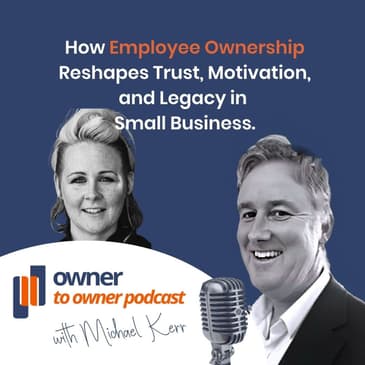
Episode Overview: In this episode, we explore the structural and cultural shift of moving a small business toward an employee ownership model. Our guest, Monica O’Malley, shares her journey in restructuring her dental practice, focusing on how this model fosters professional agency, eliminates traditional hierarchical friction, and builds long-term organizational resilience. We discuss the tangible impact of ownership on team motivation and the intentional steps required for leaders to build a lasting, purpose-driven professional legacy.
Key Topics Covered:
The Case for Shared Agency: Moving beyond top-down management to increase team engagement and problem-solving capabilities.
Building Institutional Resilience: How employee ownership acts as a buffer against industry turbulence and "perma-crisis."
Cultural Transformation: Practical steps for shifting the internal value system of a firm toward transparency and shared vision.
Legacy Planning: Strategies for leaders looking to transition power and ensure the long-term health of their practice.
Thanks for listening. Visit the Owner To Owner Podcast website to subscribe, listen back, or check out any resources or information mentioned on the show.
Search @ownertoownerpodcast on your favourite podcast player to subscribe and listen to the episodes.
Reach out to Michael Kerr via the website if you need personal assistance or advice for your small business.
michael.kerr@kerrcapital.com.au
www.ownertoownerpodcast.com.au
Connect with us:
Website: ownertoownerpodcast.com.au
LinkedIn: Connect with Michael Kerr
Share Your Story: Want to be a guest? Apply here.
Disclaimer: The information shared on this podcast is for educational and general information purposes only and does not constitute financial, legal, or professional advice.
[00:00:00] Before we begin, a quick note to our listeners. Please be aware that in this episode we discuss mental health and suicidal ideation within the dental profession. We know this can be a difficult topic for some listeners. If you find this conversation distressing or if you know someone is struggling, please know that support is available. You can find a list of confidential professional support services in our show notes, but feel free also to subscribe to our listeners.
[00:00:30] Welcome to the Owner To Owner Podcast. I'm Michael Kerr, your host, and I'm also the founder of Kerr Capital where for 22 years now I've worked alongside business owners. Owner To Owner is a business podcast to empower the owners of Australia's small and medium enterprises. Forget the slick stories of tech titans and unicorns. At Owner To Owner we get raw and we get real. Every Owner To Owner episode is a personal conversation with a
[00:01:09] another business owner. We explore the other business owner just like you. We explore the everyday struggles they face and the different pathways they tread to success. Practical advice and plenty of one percenters for better returns, less stress, and more enjoyment. You'll find grit, laughs, maybe a few tears, and some hard-won lessons only available from others who've been where you are, whatever your stage of ownership. Every Owner has a compelling story to share.
[00:01:39] So join us to listen and learn. 32 years.
[00:01:55] 32 years, a couple of thriving practice locations, hundreds of clients, but a growing frustration with the industry that she worked in. But Monica O'Malley didn't sell out to a corporate buyer. Instead, she handed the future of her business via employee ownership to the people who show up and do the work every day. Looking forward to this conversation, Monica, and welcome into the Owner To Owner Podcast. Hello, Michael. Thank you for the opportunity. Your business.
[00:02:23] Your new dentist describes itself as fueled by health, not disease. Does that make you an outsider or an innovator in a fairly old and traditional professional business?
[00:02:37] Does it make me an outsider? What a great question. I think we'd all like to think in healthcare that we are all at our heart vocationally passionate and committed to at least making a contribution to the cessation of human suffering. However, that in some respects comes at, is at odds with the commercial imperative to make a lot of money. And that's, that's the, I guess that's where I found myself all those years ago. You know, you graduate as a healthcare practitioner.
[00:03:06] You have all the knowledge and you have all the knowledge and you think you're going to go out in the world and make a big difference in a lot of people's lives. And then unfortunately you come up hard against the, the medical industrial complex or the commercial realities of, of running a business in healthcare. And essentially, if I can just speak to dentistry that, you know, 98% of what we see in people's mouths is preventable. It's lifestyle related.
[00:03:33] So if I'm doing my job well, I should run out of work, if that makes sense. Yeah. So I'm, I'm very passionate about the non-commodification of disease and I'm not sure. So to sort of circle back around to answer your question, I'd like to think that the vast majority of my colleagues in this industry feel the same way, but I'll just, you know, I'm a, I'm a cynic now. You'll leave it, you'll leave that as an open question. I'll leave that as an open question.
[00:04:00] So tell us about your new dentist today. And I know it's been 32 years at least in the making, but today, what does it, what does it look like? So we've got two practices, one in the outer eastern suburbs of Melbourne and one in a small country town called Yay. We probably have around about 10 and a half thousand clients on our collective sort of database. And we have a team of eight people across two sites.
[00:04:24] Okay. When, and I, I set this up with the, this model, you, you transitioned to employee ownership, the business trend transition to employee ownership, but you, you, you started back in 1993. Yes. And as a dental technician? Therapist. Therapist. Therapist, yeah. And then 2015, your new dentist started. So can you give us a little bit about your ambitions?
[00:04:53] You've already hinted at it, but how you got started, why you got started and what the industry looked like then and is it different now? As opposed to 93 to 2015. Unfortunately, I think there's a lot that's the same in dentistry, a lot that's, and equal parts that have changed. Biggest thing for me that I don't think has changed a lot is the lack of trust, generally speaking with the public and dentistry. So there's been a lot of, a history of trauma.
[00:05:21] People have not had great experiences for a whole range of reasons. That's a whole other podcast. But essentially I sense there's a big gap between the industry and the public. And then that feeds into dental avoidance, which then feeds into chronic ill health. So my passion is about bridging that gap, rebuilding public trust to get people to come back and basically look after their health. That has trickle-down effects, of course, across then the length and breadth of the Australian community when you have a look at the chronic disease burden.
[00:05:49] So, yeah, dentistry, what has changed in the positive, however, is that people are now starting to really acknowledge how important the health of your mouth is to the rest of your body, finally. So we might now start to see the wheel turn where we can start to see dentistry covered by Medicare and have better and stronger links with the medical side of things rather than being considered to be separate.
[00:06:10] Yeah, I haven't heard you once talk about how profitable this is and, you know, because it's care first and that's a compliment for you. And it underpins everything you do. I was looking at your website earlier. Yeah, it's not what I expect. I've looked at it a couple of times, but I realised the menu, the navigation and the site is community, legacy and impact. Correct. Yeah. That's what drives me. Very different. Pardon? That's what drives me. Yeah.
[00:06:41] The industry was also one of the things that struck me is, I think you described this dominantly a male industry. And so when I talked about being an outsider, that's also your model's different, but you're a female in a fairly heavily male industry. So, yeah, that's interesting. That's a very nuanced, there's a little bit more nuance to that.
[00:07:06] So when it comes to the dental workforce, we've got dentists, dental hygienists, oral health therapists, dental assistants, all the administration staff and dental prosthetists. And they're actually overwhelmingly female. The current data says 88% of the actual dental workforce is female. When it comes to dentists, I think it's sitting now at about 52% female versus male.
[00:07:31] I think where perhaps we're talking about the male domination as a gender thing is in practice ownership. Yeah. So I'm an outsider in that respect. There aren't a lot of women that physically own practices. Yeah. Whereas now your new dentist is effectively 100% female. Correct. Yep. Yep. And that's quite a shift.
[00:07:51] Can I, we're going to talk about more of the mechanics of employee ownership and the models, but I do want to, we were just chatting before the recent budget here has certainly raised some questions that are going to be answered over the next months and before anything changes.
[00:08:09] So we're not giving tax advice here, but we're going to the heart of your rationale for transitioning to employee ownership and in turn making it more visible and more aspirational for other business owners. So that's the purpose. But at some point for you, employee ownership appeared on the horizon. When was that? And what particularly appealed to you about employee ownership?
[00:08:35] It's really important for me in my experience of running a business that the workforce needs to be in alignment. And I know we chose to chuck that around, you know, an aligned workforce. So people having a shared vision and also a shared level of motivation and engagement. And this model spoke to me as to being one way in which that could be at least strengthened.
[00:08:58] But it also, with this particular model, the EOT, there wasn't all of the really, I guess, multiple levels of administrabia that is typically associated with share schemes. So I wanted people to be able to have engagement, input, a certain level of connection to the business. But I didn't want, I wanted it to be simple as possible. Yeah. I think what you're referring to there, there are in larger businesses, widespread employee ownership. Yep.
[00:09:26] Public companies or large companies. And there are hundreds, maybe thousands and you need a platform. In an eight person business. Yeah. You went for something that was a little bit more simple and. Simple, simple. Like when you have a look at traditional share buyback schemes, et cetera, like the legal requirements and even having an entire accounts department, a legal department devoted to the administrative of that, not going to be applicable in a small business. Yeah. Yeah.
[00:09:56] So there was a strong, was it a combination of potential impact for the business as well as you fulfilling some personal ambition or to spread ownership and have a practice that was more deeply connected with staff? So better productivity, better outcomes for patients? For sure. I mean, there are many, many layers to this.
[00:10:21] I think when we first met a few weeks ago now, there are so many different layers that are meaningful to me. If we could touch on perhaps one simple thing, which is the mental health characteristics, particularly in the dental health, in dentistry. There is a, unfortunately, a well-worn kind of, what would we call it, trope where people say that, you know, dentists are one of the highest suicide rates professionally. Unfortunately, that has actually, perhaps was once anecdotal, has actually been borne out now in terms of post-COVID.
[00:10:51] There was some research done through Melbourne University in 2021. They interviewed 1,600 participants or surveyed them. And in the 12 months previous, so 2020, and I know that was COVID, so it was a strange time on planet Earth. But say 31% of the people who they questioned had contemplated suicide in the previous 12 months. That's a phenomenal number of people.
[00:11:15] If you extrapolate that out across the industry, unfortunately, the anecdotal evidence now has some data behind it. And I didn't want my business, and again, I've been in the industry for a long time, and it is tough. There's lots that's very rewarding about the job, but there's also lots that's very challenging. And I didn't want my business to be part of, again, this grinding down of people's mental health.
[00:11:39] I wanted a place where, again, if people are genuinely showing up and in themselves feeling vocationally passionate, we can generally traverse or navigate those more negative aspects more easily. We can't eliminate them, but when you're in a team of people who generally want to be there, it's a very, very different vibe. Yeah. Yeah. So, I mean, that's one aspect, but there's so much we could talk about. Well, just, yeah, but the things that come to mind, talk about those for you. That's what I'm interested to hear.
[00:12:09] Yeah, so typical hierarchical workplaces. So, again, the typical workplaces that I have worked in, I mean, I've worked in corporate, I've worked in academia, I've seen lots in the industry. But the typical hierarchical workplace where there's the slave and boss mentality, I think that only serves, again, to perpetuate mental ill health, physical ill health. People feeling, I guess, where they're infantilized. They don't have any power or control over decision-making in the workplace. They're treated like children.
[00:12:39] They're kept scared. They're kept uneducated, unaware, and exploited. So, when I think of a typical hierarchical workplace, I'm not saying all hierarchies are like that, but hierarchies are built on a certain level of exploitation. There's going to be people at the top that are getting a certain level of reward and then a large group of people at the bottom perhaps missing out or being exploited. And I just don't want my legacy after all of these years.
[00:13:06] Again, if we circle back around, if I'm a healthcare provider, part of my soul is invested in not being part of the equation that causes human suffering. So, I wanted the business to be a representation of that at every level. In saying that, you're still actively, you work day-to-day in the business? Yes. I'm an employee like everyone else. Yeah. Yeah.
[00:13:29] How do you feel free to give as much or as little as you want, but the ownership is spread. Everybody, all have a share? Sorry, get a distribution? Yeah, if there's a distribution available. So, essentially, we have a 12-month probation period. So, once you pass that 12-month probation, you then become part of the employee ownership trust.
[00:13:54] And so, you have the potential if we do decide to share at that particular interval that you'll be part of that. So, we've got some people who aren't in the trust at the moment and some people that are. But it's basically a 12-month probation. And we only restructured in 2023. So, this is still very early days for us as well in terms of gathering momentum. Yeah. Yeah. But it's up to the board to decide whether or not there'll be a profit share. We've basically been profit sharing twice a year.
[00:14:22] So, in June or July, I should say, and then December, January. But we have to be just like in any other business, think strategically. Sometimes we determine, actually, it's not wise for us to share this time around. Let's reinvest in the business. Fundamentally, though, everyone in the business gets an opportunity to speak and have the... And there must be then also a much narrower gap between the financial information about the viability of the business and the employee slash beneficiary.
[00:14:51] Absolutely, 100%. So, maybe this ties back into a question that you alluded to before. A lot of people think running a dental practice is incredibly lucrative, that we're all just dancing around on piles of money. It's just simply not true. Running a dental practice requires a big upfront investment, first of all. And ongoing costs are sometimes prohibitive. It's a bit like the wedding industry where, you know, you go to the bakery and the minute you put wedding in front of it, add a couple of zeros.
[00:15:21] Dentistry is exactly the same. So, it's actually, the margins are pretty tight. If you are upselling and over-servicing, you're probably making a lot more money. But that's not our vibe. We are deeply ethical. And so, yeah, the margins sometimes can be quite tight. Now, sometimes, well, as a jet in a more traditional practice, a lot of those details are kept hidden from the team. We don't hide anything. We've true across a lot of businesses. There's no... Yeah, so we... The connection is not there. Correct.
[00:15:49] So, I love this model insofar as it helps us to be, well, I want to empower women around money and financial literacy. I want to empower women just generally. But also just being very open and upfront about these, this is the realistic day-to-day data of what it takes to keep this business and keep you employed. And again, if you're dealing with people who are aligned with the vision, that resonates more deeply with them. This model has been a fantastic filtering experience. So, I have...
[00:16:16] There have been people who have left the business because this just didn't resonate with them. And I'm perfectly okay with that. But certainly the financial side of things, letting the team actually see what's involved, it matters. Their levels of motivation do change. Do you think it's also educating them about what it's really like to run a small business? And is that a good thing? Yes.
[00:16:39] Because owners, you talked about loneliness and anybody running any business, it's across the board pretty lonely. There's a lot of decisions you make. You don't necessarily... You have to make them. Yes. Or you're reluctant to kind of forward or don't feel that you can trust somebody enough to go and talk about some really detailed, intimate business things.
[00:17:00] And so, bridging that gap, I mean, understanding what's going on, what drives the business from a financial point of view, but also getting exposed to some of the decisions you've got to make. You talked about holding back distributions because you need to invest in the business and that's... It's rich learning. Yeah, 100%. And so, I don't come from a business background. I actually... I was poor working class western suburbs of Sydney. I'm one of eight children, number seven of eight.
[00:17:27] I was brought up to believe as a woman back then that I was either going to be a mum, a housewife, a secretary or a cook or a cleaner. Like, that was it. No one had ever been to uni. I trundled out of year 12, had no idea what I wanted to do with my life and I ended up being a dental assistant. And it was through the mentors that I saw along the way, obviously, that I saw doors opening for me. And I saw getting an education as fundamental for me to break the poverty cycle.
[00:17:54] So, there's an element of this in, again, paying it forward. And, again, just thinking about financial literacy, problem solving, due diligence, making good decisions, having a level of personal agency in your life. Yeah. I think is so valuable for anybody, irrespective of your gender.
[00:18:10] And now, if business, if the thing that you're spending most of your time at every day, if that's helping you underpin those more fundamental life skills, like, again, we talk about a transformational workplace, this model, again, helps facilitate dialogue like that. Yeah.
[00:18:27] Yeah, on the literacy piece, and one of the things that I've written about a few times and I come back to in a lot of these podcast discussions is the typical balance sheet of the average Australian family and business equity. There's a whole lot of things that – it's from the ABS. Yes. But the average family has a house. This is across the country. Some don't. I know there's all sorts of issues with affordability.
[00:18:55] The point for me is that business equity is about – there's about eight categories of – that make up the wealth of the average Australian family. And housing superannuation, motor vehicles, furniture fittings and flat screens. And then business equity comes in at about number – comes in below furniture and fittings in a house. Yes.
[00:19:19] So one of the things about employee ownership that I think is so – there's so much potential to maybe not completely reweight that balance sheet, but at least start to open the eyes for employees to the possibility of doing better financially out of their business other than just being Australian employee.
[00:19:43] And that particularly excites me because there's so many small businesses across the country that – of eight people or six or 12 or 14. And we talked about the large companies use employee ownership for the reasons of retention and loyalty and reward, but to potentially change them, grow more business owners. Correct. Exactly. Yeah.
[00:20:10] So educate people, empower people to have agency over their own life. Not everyone wants that, but this at least gives people the opportunity. Yeah. Couldn't agree more. I mean, we spoke briefly about wealth inequality. And again, I talk about the pink collar recession. So typically women in and out of the workforce, for various reasons, they don't often have the same super accumulated as their male counterparts. So being able to redistribute some money and give people that equality, it's powerful. Yeah.
[00:20:40] And also along the way is what you're doing is, you know, by exposing employees to what's going on in the business financially, it's not always easy. It's not always financially lucrative. Nope. You have to make some really hard decisions. And when you're an owner, you know that. Yeah. You've got to make a decision to spend some money that you could otherwise take out on new equipment or a new site. Or, you know, there's always plenty of things to keep investing in.
[00:21:10] And, yeah. It's, you know, I'd say that a lot of the small business owners I deal with, the awareness of employee ownership in the way similar to what you were doing is increasing. But it's still, it's a really low, it's still at a really low base, I think. Mm. Or misunderstood. And there are, there's quite a range of models to do employee ownership. It's, you know. Yeah. It's an opportunity, but.
[00:21:38] I think for me, what's coming up for me just hearing you speak there is the element of trust that in a typical, maybe typical hierarchical workplace or a traditional workplace setting, the dynamic of not trusting your employees is still unfortunately alive and well. So in some way, the employee has to be monitored, has to be coerced, has to be corralled in some way for them to be productive. And, of course, these kind of newer models require that you need to unlearn that.
[00:22:07] You need to unlearn that and understand that these people are and can be highly motivated, highly educated, highly engaged if you give them the opportunity. That in a lot of businesses, there's a lot of unrealized human potential that everyone could be benefiting from. But unlearning those old dynamics and learning to trust again is so important. Yeah.
[00:22:28] It's shining through that you're, you know, a believer in you want your patients to do the same kind of learning as well as your employees. And it's really. So, I mean, it's funny. Dentistry is a high trust industry. You know, a lot of people have had trauma around our early experiences in dentistry. Your mouth, just if we talk from a physiological point of view, is your survival. You know, this is where survival is. This is where you eat, where you breathe, you talk, you speak.
[00:22:57] If something has happened in there that's not so great, you're going to want to protect it. So your primal brain is there. Yeah. Protecting your mouth. So trust already. Dentistry is a very high trust industry if you're doing it well. And again, I want the business model and the business structure to be reflective of that from at every level. Yeah. I mean, we've met a couple of times at employee ownership orientated professional sessions.
[00:23:24] Do you mix with other business owners outside of dentistry? Yes. And my feeling is that employee ownership is still a long way to go. But is that your sense of when you, does what you do or what you've done, you know, a real topic of conversation and a new area for a lot of those owners? Absolutely. And I'm largely considered, I mean, I get various responses when I get a bit passionate about what it is I'm doing.
[00:23:52] I'm either thought of as naive. I'm either condescended to. Oh, there, there, little girl. Who do you think you are? Mother Teresa. You're not going to save the world. There's a lot of that that gets projected at me. Alternatively, I get a lot of people who are thoroughly excited going, oh my God, this is amazing. I would like to learn more. And I think if that's one of the key messages for, I mean, anyone who wants to launch anything new, you're going to have some people that project negativity at you or insecurity because they couldn't conceive of it in their world.
[00:24:20] And you have to, again, get really good at transcending that and staying on your path. And you seem to me to be quite clear that there has been a pathway. You started as an assistant technician. Assistant, yep. And then I started as an assistant, a dental therapist, and then I became a dentist.
[00:24:40] And it was later, it wasn't straight out of uni, so there was some years of experience to form a good reason to go into something, you know, to go to the next level and become a dentist. Yes. So you had a strong desire to do that.
[00:24:59] At that point, were you also seeing a profession, a career, but also an opportunity to impose your view of the world? My flavour on things? Yeah. Hi there. Just a short interruption and a message from Kerr Capital.
[00:25:19] Kirk Capital specialise in advising business owners who want to get sale ready or, as is increasingly common, get approached out of the blue by a potential buyer. If this is you, I know there'll be plenty of big questions and a lot of uncertainty. We're expert at supporting owners in making significant personal business decisions and then helping create a really strong plan of action.
[00:25:44] If you want to find out more, contact us at the Kirk Capital website and then we can book a 45-minute no-obligation discovery call. Now let's head back to the podcast. Yeah. Again, I think these things happen organically. You know, doors open, you walk through them. It seems to resonate. Let's keep moving through.
[00:26:09] My pathway has been definitely non-linear and I'm very happy of that because I've been able to experience industry across the length and the breadth of all the different structures. And context. Fundamentally, it's very rewarding to help people. It's very rewarding when someone comes to you and they have a problem and you can fix it for them. And you didn't have to form seven subcommittees and have a planning steering committee and all of the bureaucracy. So healthcare is really, I love the direct hands-on approach to that.
[00:26:38] And then I saw the opportunity that I could fundamentally, or on some level at least, leave my little section of the industry better than when I started. You know, when you finally leave, what are you going to leave behind? I'm not sure I'm answering your question properly on this one. No, it's really interesting. But it is, you're tying it back to there was a sense of legacy even quite early. Yeah.
[00:27:05] I think, I believe I'm, personally, I believe I'm a better practitioner because of the pathway that I followed rather than someone who went straight from school into uni and then out the other side. And doesn't actually have a perspective of the team or the industry at multiple different levels.
[00:27:26] And I would like to see more dentists follow a very similar path so that we end up, again, if we circle back around, higher levels of public engagement, rebuilding public trust, dealing with an industry who are vocationally passionate. Yeah. So part of that probably is making sure the right people are doing that role, that profession.
[00:27:47] And, you know, the pressure on the recent, you know, the last 10, 20 years, the pathway to go to uni and get a degree and do this and then do that. And it's pretty enormous. I mean, there's some pretty lucrative opportunities. But there's also, it seems like it's a bit of a, you know, cattle run, you know, that even go back to school where, you know, you've got to pick a path and you've got to, you know, go through it.
[00:28:13] And, you know, this allowing for trying some other things and coming back to what you really want to do, what you really think now that you're suited to at age 25, 30, 35 is, you know, I think that's really worthwhile and valid for some. Absolutely. Absolutely. It's, I'm glad that you mentioned that because what comes up for me too as well, in dentistry, there's very much the people at the top of the heap who we often have, you know, what have I got now for qualifications?
[00:28:43] I've been to uni a lot, very educated. And then you've got the broad spectrum right down to, again, in a typical hierarchical workplace, usually young girls who finish school in year 12. They don't really have any other qualifications behind them. And that's it. And it's kind of capped at that. There isn't a big or a significant or substantial career pathway for other members of the team.
[00:29:04] And so there's, in a traditional structure, a constant churning of people who kind of come in, they exhaust their capabilities at that level, and then they leave. Or they get stuck and they get depressed and they stagnate. So employee ownership for me, again, is a modality which I intend to use to help every single person in the team transform, grow, get different qualifications, to enrich the business, to diversify the business and be rewarded for that.
[00:29:33] Not everyone wants to go to uni. Not everyone can afford to go to uni. But within certainly my strategic plan for this business, we want to diversify and utilise people at whatever level of academic level that they reach. Yeah. Yeah. And as you said, individuals in any business or any organisation, you need people at different levels.
[00:29:55] And if people feel like that's where they want to be, and then you layer on some, they're part of the business through employee ownership. Correct. And they're happy in that role for longer. There's no churn and there's a line between the important role they're doing at whatever level it is, plus they're an owner. I think it's a real deal. Correct. So in fact, it matters. You know, I don't care if you left school at year 10. Your voice still matters. Your input still matters.
[00:30:24] And we recognise it. And we recognise it formally. Yeah. Yeah. Yeah. Yeah. I mean, there's a lot. Yeah. And this is, so do a good job, be happy, be effective in the business. Everybody respects that there are different roles to be, and in every business, there are different things that need to be done. And not everybody's good at all those things. Correct. So you have the right person. Yeah. Yeah.
[00:30:47] So this, again, this model, I believe is a really good filtering exercise if people are wanting to find the best of the best in their business. It's a really good filter for the people who maybe are actually a bit half-hearted and dragging the chain and need to perhaps move on. Did you have an experience of people coming because it was employee-owned and then going, oh, it's a bit harder than I thought or not quite what I thought? We haven't really been operational in this model for long enough, I think, to answer that question accurately. Yeah.
[00:31:15] What I can say is that, yeah, when I get passionate about what it is we're trying to achieve and I'm sort of revving the team up and setting audacious goals, dream big, as they say, for some people, they hear it initially and think, gee, this sounds great. But then boots on the ground when you realize sometimes there's a bit of work involved, that's when they go, oh, actually, nah, a bit harder than I thought, I'm out. Okay. Yeah. So how long has it been?
[00:31:39] Because I want to go just into how long it took and who you used as advisors, just some practical stuff like that. Yeah. So we opened here at the end of 2015. And then by the end of 2016, I hit a brick wall. Like I thought, what the hell have I done? I've opened this business. I'm on my own. It's really tough. And I really had like the long dark night of my professional soul. I thought, oh, gosh, maybe I should just give up now. It's all too hard.
[00:32:08] That was the point at which I said, no, if you're going to do it, there's got to be a better way to run a business. So I actually started my research down the rabbit hole in 2016. Of employee ownership? Well, of another way of running the business. Oh, okay. By that stage, I was already tired of hierarchy. I was tired of having to feel compelled to drag people along with me to constantly motivate people, to constantly supervise. I was just tired. So I started that research 2016.
[00:32:38] It was 2017 that I discovered Burtsog. Have you heard about them in the Netherlands? That's when I discovered, yeah. That's when I discovered them. Yeah. I heard you talk about it at one of those sessions we're at. Yeah. So it's an aged care service based in the Netherlands. It was started by a male nurse by the name of Joost de Bloch. And he too was frustrated in the Netherlands with corporate healthcare, essentially.
[00:33:06] He and I think six friends started it. And they run the business that's very much decentralized. So small groups of people that are allowed to self-manage. So they're given an area, let's say 10,000 square kilometers, whatever it is. This is your community. Go forth, find out what they need and help them out. So they basically provide aged care services to keep people in their homes for longer. And when I heard this model of self-managed small teams that are decentralized, I was
[00:33:36] like, yeah, this sounds like your average private practice. Initially, I thought, okay, well, we can scale, then we can get bigger and we're going to use the self-managed team model. And that was kind of then started me down the road of finding out how do we engage with the employees? How do I find the most passionate people who are most vocationally motivated? And how do I put them all under one roof? So it was Bert's, and I actually went to the Netherlands and met with Joost and his team. And I spent a week over there and that was in 2019. And then COVID hit.
[00:34:05] And that was a really, really interesting time because that was the first time in dentistry where effectively we had our business, the control of our businesses taken away from us as everyone did with the lockdowns, et cetera. So 2017, 2019, 2020, it was finally, I just kept, I kept going saying there's got to be a different way to run the business. And so for me, when I discovered employee ownership, I reached out to Employee Ownership Australia. I think it was the end of 2020.
[00:34:33] And I just said, look, I really want to try something new. What have you got for me? And that's when I discovered the EOT model from the UK. And we started a communication with Graham Nuttall. And yeah, I guess they say the rest is history. The formal administration bit of it in terms of the legals, writing up the paperwork, forming the board, I should say forming the new entity that took place in 2023. So July 1st, 2023. Yeah.
[00:35:00] So you initiated all this quite a way before that COVID got in the way. Yes. But it was driven by you wanting an alternative and a better way to thrive in your business and your practice. Yeah. I want to work with people who want to come to work. Yeah. Yeah. And you don't like hierarchy. And I don't like hierarchy. And I don't like exploitation. Yeah. Yeah. Yeah. So very quickly to round it out, because I have permission to speak as well.
[00:35:29] So my solicitor, her name is Melanie Heffernan. Her business is Southeast Lawyers here in Croydon in Melbourne. And she was phenomenal because all of the documentation had to be created from scratch because no one had ever done it before. So she created all of our documentation for us. And she's more than happy for people to reach out and chat to her as well. Excellent. And my accountant firm is Trident Financial, Hayden Stewart. They both put a lot of faith in me and saying, right, well, again, I think people are just used to me trying new things.
[00:35:57] And we just all thought we're going to give it a crack. Life's short. Yeah. Yeah. So you engaged. Was that the longstanding advisors? Yeah. But who also understood what you were trying to achieve and also enough about legislation to create what you needed? Yeah. And look, we all accept that there are still, as we've even said with the newest budget handed down, there's still so much that's changing the world. But I don't think that's ever going to change. That's business. Yeah.
[00:36:27] It is. And it's a bit like we were talking about earlier. It's just got to, if you can decide what kind of business you want to run and what your legacy might look like or what your exit plan might look like or what your success, then you're going to expect to get bounced around. Correct. But if you have that vision and clarity about what you want to do, you'll most likely find a way. Yeah. I think it was a Peter Drucker quote that I read recently.
[00:36:56] And he basically said, you know, at the time of the crisis or when the storm is bearing down upon you, it's not the storm you should worry about, but it's reverting back to the old way of doing things. Yesterday's thinking was the problem, not the storm. Yeah. Yeah. Like that. Yeah. All right. So in terms of, can I ask about the practice, that structure you have in place? Yeah.
[00:37:23] Is your intention that the practice, the two businesses just go on and on and on and on and leaving you as the founder to decide to do something else? What I'm getting at is a lot of, some of employee ownership is about exit planning or succession planning. So the founder, the owner can retire, go do something else, leave it with the team, whatever.
[00:37:53] So is that your, you see yourself and the, sorry, the practice surviving. Beyond. Yeah. Add for an item and then you having some flexibility at some point to say, well, I want to do something else. Correct. So I, my intention is that the business goes on and on and on, even if I did exit it, that we would have created a robust enough culture that the people within it will continue it on.
[00:38:19] I think in, in trust law at the moment, discretionary trusts, they can only exist for 80 years. Okay. I think that, that's one of the things that I came to learn. So we've got 80 years or however many of us, 70 something left, but it has been written into our constitution and I'm, I'm passionate about this, that it will never be sold to a corporate. So we have perpetual succession. It will never be sold to a corporate. Yeah. Yeah.
[00:38:43] So if you wanted to go start a, a charity or not for profit around financial literacy for women and you needed to spend all of your time on that. Yes. What does it look like for you personally as the founder? You go replace, like you have to be a, you have to be, cause you're, are you the, the one, how many dentists in the practice? So physically I'm, I'm one dentist. We have an oral health therapist and we have two hygienists.
[00:39:13] So when it comes to a practitioner, because that's principally how cashflow is derived at the moment, although that won't always be the case. We call it, I'm sitting here in my clinic at the moment, we call it the drill and the fill. You know, the chair at the moment is the principal cashflow element. As long as a, we have enough clinicians practicing, the business will go on. I can step off and do other projects by all means.
[00:39:37] As long as I am replaced by someone who is equivalent in terms of their level of skill. You know, it's not unlike any other business. We've got to think about risk mitigation, et cetera. We don't just bring anyone in. But yeah, I want to, our goal is to diversify the business such that the drill and the fill isn't the only thing that we do. We can branch out into education. We can do all sorts of things. Yeah. But there's, is, is there an exit event where you can, you know, you put all that time and so for your own personal financial.
[00:40:07] Oh yeah. Yeah. Yeah. That's, that's a, that, so there's that straight up exit part of it where you can enjoy the benefits of having put all of what you've put into it over a long time. Yeah. So how we're transitioning at the moment is that I'm effectively buying the business, the business, the, the new entity that we've created is buying the business off me. And that's happening incrementally now over the next five, might even stretch out to seven years. Okay. So I'm, I'm sort of being paid in the background.
[00:40:38] Yeah. So you're effectively transitioning out of ownership, well, a hundred percent ownership to whatever your share might be as an ongoing employee. Correct. And that seems to be the timeframe because that you, that other entity, and we're not talking, we're not giving tax advice here. No, no. But it's, you know, the, the business itself is actually funding your, your exit. Yes. Yeah. Yes.
[00:41:04] And five to seven years seems to be the kind of timeframe that you could contemplate. And this is, you know, for me across a whole, you know, I do work in a lot of, across a lot of industries, but they're, the, the characteristic is many of them are classical SMEs between five and 20 employees. Yes. And the owner is, owners generally are getting older and older and they need, they need to have an exit event at some point.
[00:41:32] And, and that's not just necessarily about, you know, flipping it. Some do, and that's great. Some, you know, want to explore other alternative exit pathways for a whole host of reasons, including legacy, the business has meant a lot more to them than just the money. Yes. It could be staff, could be customers, could be in rural or regional locations, a sense of if, if I don't, if this business doesn't survive, the whole place is the worse for it. Yeah. Yeah, yeah. Absolutely.
[00:42:02] So. It's a weight. Yeah. Yeah. So there's pressure on you. I mean, we have a rural practice at the moment and we know if we exited that town, that leaves a big gap in, in, again, the health of that community. That's a humanitarian issue, you know? Yeah. We don't, we don't want that business to exit. We want it to continue on. Yeah. Yeah. Yeah. And, and that's exactly what I was talking about is you, you feel that, you know, that
[00:42:29] in, in the metro areas, there may well be, if it's not that one, you can drive two Ks and get to that one. A hundred percent. And, and, and others. It's, it's, it's a bit of a drive then. Yeah. So my, part of my strategic plan, I think at the beginning of last year, I wrote a 10 year strategic plan for the business. So I'm at least here till I'm what, 64. And I specifically, if, and when it's time to expand the business, it will only be done
[00:42:56] again, as I've said, with small self-managed groups, but we very specifically want to head out into the rural regional parts of Australia because that's where there's a big deficit in health access to healthcare. Yeah. Yeah. Yeah. Can I just go back to start? You see, you've, you've talked about a transformation and, and, and getting the right people in the right roles. Yeah. Is that, is that, what's the practical day-to-day reality of, you know, of introducing somebody,
[00:43:26] a new employee to the idea of employee ownership and you still got to do your job and, you know, I mean, it's not all beer and Skittles. It's not all unicorns and cupcakes. That's a really interesting question. So I'm going to keep coming back to the, actually there's probably two ways in which I can answer this question. First of all, fundamental, we'll go back to trust again. So someone might come into the business and I'll be speaking and the team will be speaking and they'll get lots of documentation around culture, the expectations, how we, how we conduct ourselves, et cetera.
[00:43:56] And then they might actually then go home and have a chat to mom and dad or their significant other or their neighbor or their friend. And they may again be exposed to some cynicism. I don't know whether you can trust this. And that's really interesting. So although we're very passionate and we've been speaking this conversation and in this dialogue in this space for a long time, we're very comfortable with it and we're happy to move forward despite the unknowns and we're fundamentally optimists.
[00:44:22] People then go back out into a more traditional environment and sometimes can have seeds of doubt planted. And so then you kind of got to work around that. It's just an interesting sort of, if you talk about the logistics of the day to day. Yeah. It sounds a bit scammy to me. Sounds a bit scammy. Like, can you trust her? Like, really? Is this, this all sounds a bit too, too, too. Are they punting you properly? She sounds a little bit too nice. Yeah. You know, can you trust her? So that's been an interesting thing. The other thing, the other way I like to describe when people do come into the business
[00:44:51] and this is a conversation I have with them. I say, have you seen the movie Charlie and the Chocolate Factory? You know, what Willy Wonka is doing, he's trying to find the people who should take over the legacy of the business. And so he gets in the kids and he essentially puts a bit of heat under them to see who are you? When I'm not around, when I'm not looking, who are you? And I basically tell them, I'm looking for a, dare I swear, a shit ton of Charlie buckets. I'm looking for honesty. I'm looking for transparency.
[00:45:18] I'm looking for when it matters the most, when the brown stuff hits the whirly thing. Are you honest? Are you transparent? Are you hardworking? Are you reliable? I want Charlie bucket. If you're Augusta Scoop, if you're greedy, I'm not interested. If you have a root assault, if you can't handle your emotions and you're going to have a tantrum every time you don't get your way, I'm not interested. So this is the dialogue we have. Yeah. Yeah. Yeah. So there's a period of socializing the idea. Yes.
[00:45:45] And yeah, it's not something you can just jump into. And I mean, it's like anything transformational or anything foundational like that. And it's part of what we were chatting about earlier, which is there is a very, very big divide between straight employees and then the hustle that is needed to start, sustain a small business.
[00:46:08] And we've got a big gap to that where I feel strongly employee ownership is it's going to take a long time. It's going to take time. Yeah. It's giving exposure to employees and giving owners deeper understanding of employees and what drives them and what motivates them. So it goes both ways. Humans are complex. Yeah.
[00:46:32] And dare I say, I know I'm probably using lots of different quotes and all sorts of things, but you've heard the saying planting trees under which you probably won't be sitting. Yeah. Yeah. Yeah. I see it all the time and think about that one all the time. Yeah. Yeah. Yeah. So one of, I don't know what the numbers of eight employee businesses that have transitioned to employee ownership in Australia. I suspect it's tiny. Not many. Yeah.
[00:47:00] If we had a hundred other business owners in the room, you already, you talk to some of these informally and you get the same, a bit scammy, but what's going on here? But some believers as well. But what's the one thing that you'd say to those 100 owners who might be the next wave of owners to transition to some kind of employee ownership plan? What would you say to them? Hmm.
[00:47:26] The planet Earth is a more chaotic and potentially scarier place right now than perhaps it ever has been. And I'm not sure that's ever going to change anytime soon. I think the term perma crisis has become part of our vocabulary now. And that for a business to be resilient, in my opinion, requires collective wisdom and that you can't any longer rely on one person being able to make all the right decisions.
[00:47:53] And so being able to engage with a group of people who are truly in alignment and you've learned to trust them again and you're prepared to have your leadership skills tested, I would say this is the way forward. Yeah. Is there a sense of, yeah, perma chaos? I hadn't actually heard that. The perma crisis, yeah. Yeah. Yeah, perma crisis. Yeah. But the widening gap in everything. Yes.
[00:48:17] So to have a small business that's a good environment that you and your team control to some extent you can. Yes, to some extent. Yeah. Is what we're talking about here. Yeah. Having a level of agency in your own business. Yeah. Yeah. And therefore, you know, your life. Exactly. Everybody. It ripples out. It actually has to work.
[00:48:43] And may as well make it more enjoyable and get some more from it. Correct. And I'd say, I want at least my business legacy for your work to be something that enriches your life and not makes it worse. Yeah. It's fantastic, Monica. All right. Final question. Right. This is, you got plucked. Someone's listening to the podcast said, we're going to get Monica up here to Canberra. She'd be great running the federal small business department.
[00:49:11] You have to rock up next Monday, put your feet under the cabinet table. What are the couple of things that you're going to drive home to make small business, small, medium business, a more sustainable and viable part of our economy? Gender equality. We need to tackle it, particularly in healthcare. So I call, you know, it's the caring economy. It's driven by women.
[00:49:33] When you think of education, when you think of healthcare, aged care, and there is a lot of exploitation happening where people aren't being rewarded. And that gender equality piece needs to be attended to. That's the first thing. And the other thing is, are you ready to put your ego to one side and learn to trust that there are a great many people in the world that have a lot to offer if you give them an opportunity? Yeah. Some belief. Yeah. Get back to some belief. Yeah.
[00:50:02] Are we ready to stop being elitist thinking that just because we're the ones that have all the letters after our name, that we somehow have the golden ticket and understand the problems and are the only ones that are able to offer solutions? Yeah. Thank you. They're really thoughtful and entirely consistent with what I thought you would, who you are and the way you run your business. So I really do appreciate those, Monica. Thank you.
[00:50:32] Much appreciate your time today. You've mentioned you're a lawyer and accountant. We'll make sure of those details in the show notes. Someone else. I'm particularly interested in other owners sparking, more than sparking, making them aware that somebody else has done it and it can be done. Yes. So are you happy if we share your details as well? Absolutely. Excellent. Yeah. All right.
[00:51:00] We'll do that in the show notes. Great contribution to driving employee ownership and congratulations on everything you've achieved. It's been great to hear it firsthand. Thank you. I'm sure it's going to inspire another way. Thank you, Monica. My pleasure. Thank you so much and thank you for your interest in it as well and for the work that you do. I think connectedness is so, so important. When you're on a journey like this, sometimes it can be very, very lonely and you think, am I the only one that sees the world this way?
[00:51:29] And that can be a temptation then to take a step back and go back into your box of familiarity and comfort. But once you know, actually, there are other people who see the world this way, it's a whole lot less lonely. Yeah. You did something about it. You went, you took off to the Netherlands and, you know, so you weren't, you had to scratch that itch and. Yeah. That's incredibly admirable. So thank you. All right, we'll leave that for today and look forward to catching you another time, Monica. Awesome. Thank you.
[00:52:07] So thank you very much for listening. I hope you enjoyed this episode of Owner to Owner and got some helpful advice and maybe some more clarity on how to make your business work better for you. To subscribe or to listen back or to access any of the resources or information we talked about in this episode, head over to the website, owner2ownerpodcast.com.au. Or you can search up Owner to Owner Podcast on your favorite pod player.
[00:52:37] If this episode or the podcast generally is really helpful, I'd love it if you could leave me a like, a rating or review. But even more than that, I'd love it if you could share it with another business owner. There's a new episode out every couple of weeks. I'll catch you then. Thanks forυχity. Bye. Bye. Bye.êu