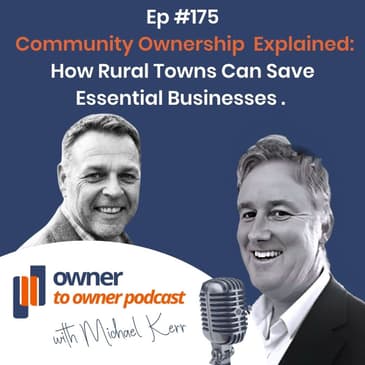
Most rural communities are facing a critical crossroads: how to preserve essential local businesses when traditional ownership models are failing. What if communities could take ownership themselves—reclaiming their future one business at a time?
Matt Pfahlert founder of Community Owned Australia, explains how regional communities can take a step towards buying and operating the assets they can't afford to lose.
Drawing on successful models from Australia and overseas, Matt shares practical lessons on community ownership, social enterprise, governance, funding and long-term sustainability.
This conversation explores what happens when ownership transition fail, how communities can identify opportunities worth saving, and why entrepreneurial thinking remains essential even when profit isn't the only objective.
If you're interested in business ownership, succession, regional development or the future of rural Australia, this episode offers a fresh perspective on keeping communities alive and thriving.
Key Topics
- The role of community ownership in preventing the closure of essential local businesses
- The powerful concept of "recombinant innovation"—bringing proven strategies from overseas and adapting them to local contexts.
- How rural communities can leverage local networks to acquire assets
- The importance of entrepreneurial mindset and operational discipline in community-run businesses
- Examples of related models from overseas
- Practical steps for communities to start their ownership journey using the Community Owned Australia framework
- The significance of long-term planning, succession, and shared services to sustain rural businesses
- Policy insights for government support, including easing regulations around superannuation and incentivizing rural investment
Timestamps
00:00 - Introducing the importance of community ownership in rural Australia
01:11 - The risk of losing key community assets and the concept of community buyback
01:55 - Matt’s background growing up in rural communities and early entrepreneurial ventures
04:19 - Lessons from youth entrepreneurship and trading in small towns
05:30 - Moments that highlighted the need for alternative ownership models
07:45 - How overseas models inspire Australian solutions
09:44 - What
Recombinant Innovation
means for community-led ventures
11:30 - The principles and scope of
Community Owned Australia
12:09 - Diagnosing community needs and supporting local enterprise creation
14:02 - Building feasible business models with technical support and grants
15:20 - The importance of community governance, local investment, and co-ownership
17:23 - How to leverage external networks and mentorship for rural projects
20:05 - Changing community perceptions and motivation for local ownership
21:28 - The impact of local small businesses on retaining population and improving local appeal
22:39 - Identifying the types of businesses suited for community ownership
23:57 - Stages of community readiness and initial steps for engagement
26:11 - Role of entrepreneurial discipline and operational excellence in community ventures
28:00 - The significance of professional management and governance roles
29:32 - Innovative ideas like renewable energy projects to boost local economies
32:48 - Strategic planning, business succession, and understanding local business ecosystems
35:53 - Financing, valuation, and overcoming bank reluctance in rural asset ownership
38:04 - Engaging local champions—women, community leaders, and long-term residents
39:21 - The shifting mindset: from curiosity to motivation for rural community ownership
43:39 - Examples of successful buy-backs and their long-term asset value
44:40 - How communities can initiate with minimal risk through expressions of interest
47:21 - Hypothetical: What Matt would do as Australia's small business minister
48:48 - Final thoughts and how to get involved with Community Owned Australia
You can register your interest here Community Owned Australia
Other resources & Links
Thanks for listening. Visit the Owner To Owner Podcast website to subscribe, listen back, or check out any resources or information mentioned on the show.
Search @ownertoownerpodcast on your favourite podcast player to subscribe and listen to the episodes.
Reach out to Michael Kerr via the website if you need personal assistance or advice for your small business.
michael.kerr@kerrcapital.com.au
www.ownertoownerpodcast.com.au
Connect with us:
Website: ownertoownerpodcast.com.au
LinkedIn: Connect with Michael Kerr
Share Your Story: Want to be a guest? Apply here.
Disclaimer: The information shared on this podcast is for educational and general information purposes only and does not constitute financial, legal, or professional advice.
[00:00:07] Welcome to the Owner To Owner Podcast. I'm Michael Kerr, your host, and I'm also the founder of Kerr Capital. For 22 years now, I've worked alongside business owners. Owner To Owner is a business podcast to empower the owners of Australia's small and medium enterprises. Forget the slick stories of tech titans and unicorns. At Owner To Owner, we get raw and we get real. Every Owner To Owner episode is a personal conversation with another business owner just like you.
[00:00:34] We explore the everyday struggles they face and the different pathways they tread to success. Practical advice and plenty of one percenters for better returns, less stress, more enjoyment. You'll find grit, laughs, and some hard-won lessons only available from others who've been where you are, whatever your stage of ownership. Every owner has a compelling story to share. So join us to listen and to learn.
[00:01:10] What happens when the last servo shuts or the only bakery or pub in town closes? Across regional Australia, tens of thousands of businesses are owned by people who are ready to step back and too often there's no successor. But the community can't afford to lose this service. In this episode of the Owner To Owner Podcast, we're asking a simple but a big question. What if communities could own these assets they can't afford to lose? I'm talking with Matt Pfahlert. He's going to talk about community-owned Australia.
[00:01:40] New models of ownership and how rural towns can take their future back one business at a time. Matt, you founded Acre in 2012. Recently community-owned Australia. These aren't your first radios. Can you give us a couple of minutes about Matt Pfahlert?
[00:01:55] Good to be here, Michael. And of course, everyone's favourite topic is themselves. So yeah, happy to oblige. I grew up as a rural kid and very, very small rural communities, mostly Western Riverina, and just didn't know that I was actually a rural kid until I went to the city some years later.
[00:02:13] And it was there that I realised I didn't fit in. And this kind of other crazy thing, which is I didn't care that I didn't fit in. It was like, actually, I'm not meant to be here. I'm actually a rural kid and a rural person. So it was a lovely realisation that I knew I wanted to work in the outdoors, I wanted to work in the bush, and I sort of had this ability, I suppose, to work with youth at risk.
[00:02:39] And it's probably because I wasn't that far away from being one myself, that I was able to kind of empathise with those kids who were falling out of the school system. I was a non-academic learner myself. I started my first business when I was 13 years old, getting to high school. The little town where I was in was the feet of four or five surrounding farming districts.
[00:03:02] And I realised on the first day of high school that none of these kids coming in on the buses had access to chips, chewing gum and lollies. So seeing an opportunity. Within a few weeks, I had a thriving little business going where I'd be providing those services. It wasn't exactly a legal business at the time within the confines. A bit of cash under the table.
[00:03:24] Yeah, a bit of cash under the table. But if I think back, it's probably I was making an equivalent of about $200 and $250 a week now. Yeah, back then when a packet of twisties was eight cents. So I had to employ other kids and I had to manage expectations and do all that sort of stuff.
[00:03:45] But it was actually when I was 13 and towards the end of that year where I did something really stupid, which was I walked the corridor. And in a junior school at the high school I went to, you only walk the corridor past the other township groups if you wanted your head kicked in. And I thought something just came over me and I thought, OK, well, what if I do this? Am I going to get bashed up? Wouldn't it be a good test to see whether I'm actually required by these kids around the things I'm supplying them with?
[00:04:13] Yeah. And I walked through and I didn't get belted up. He's all right. He's all right. And I thought, OK, actually, I think I know the rules of the game. And the rules of the game is that if you can trade, you can find something that someone wants and you can supply it, not rip them off and be trustworthy and be reliable. Guess what? That gets you a long way in life. And so I've never, ever worried about money.
[00:04:34] But I have worried about people who weren't as lucky as me that, you know, had real trauma and dramas happening in their lives and were non-academic learners as well. And so my kind of career, I found myself in youth development and the intersection between community development and economic development around this idea of people seeing themselves as their own brand and seeing themselves as a self-determined trader so that they can get along and live a fulfilling life.
[00:05:02] So that's the real motivation behind everything I've done. I set up a farm. And there's been a long list of things that you've done and achieved. Yeah, that's right. That's right. Yeah. Typo Station was the first venture around at-risk youth. Yeah, yeah. Yeah. Look, it's a really earthy background. And I can see why, you know, you're right at home where you are and in the work you do.
[00:05:28] Can we talk about a moment, like you touched on it there, but was there a particular community business or moment that made you think we need a different ownership model here? Or was it really stark where you saw a whole town at risk because there was a key business about to fall over or not to have a succession plan? There's probably a couple of moments.
[00:05:54] And the first one happened in 1996 when, you know, through the work that you mentioned there with Typo Station, you know, a residential program on a remote farm, you know, simple living and residential with first offenders. You know, young people falling out of the school system, starting to get in trouble and all that kind of stuff. And for that work, you know, I was already running social enterprises, you know, with those students.
[00:06:18] We also had another business running on the snow road out of Millewa and, you know, wealthy people going up to the snow would come in and buy sort of fine furniture. You know, it was really high quality stuff. And so we're already kind of on our way there. And I was lucky enough to be awarded Young Australian of the Year for that work. And it was an absolute curse. And it was a curse because all of the funders that had been on the journey with us to that point in time pretty much left the building. They thought, oh, yeah, Matt's made it.
[00:06:48] He doesn't need our help anymore. The role of Flansby is to get things up and running, not to sustain them. And so I found myself, I'm thinking it's going to get easier from here. Actually, it only got harder. But the second bit of that that I feel really ashamed about was that I had young people from all over rural Australia ring me up and say, hey, can you be my mentor? And can you help me? I've got an entrepreneurial idea. And, you know, no one treats me seriously.
[00:07:15] I've taken it to local leaders in my community. You know, all of these things. Can you help me? And I was so overwhelmed with what I was doing. I think about 170 times that year, I was on the phone saying the same thing. Look, I wish I could. I wish there was somewhere I could refer you to. I wish I could provide you with some time and some mentorship. But unfortunately, our country doesn't value young people and ideas. And I remember saying, unfortunately.
[00:07:44] And so that stuck with me. That just stuck with me from, and I didn't do anything about it for years and years and years until 2009 when the second ever Social Enterprise World Conference, by pure coincidence, happened to be in Melbourne.
[00:08:00] And I went along because I was going to be seeing and meeting some of these people I've been reading about who in the Northern Hemisphere had been rejuvenating whole rural communities through, you know, buying local assets and turning, turning, you know, poor performing businesses in growth marketplaces, buying them, getting local, local investors and turning them into social enterprises the next day. And when I read that stuff, I'm going, oh my gosh, that is seriously cool.
[00:08:28] Imagine meeting some of these people. So here I was at the conference and I met them and guess what I said? Will you be my mentor? And so that really set a whole train, you know, in play. In 2013, I was lucky enough, you know, Acre was already up and running by then. Which is the Australian Centre for Regional Entrepreneurship. Rural, rural. Sorry, rural. No, that's all right, mate. That's all right.
[00:08:52] And so that was, okay, there are all, I know there are already communities, rural communities that have been in severe decline now 15, 15, 20 years later, are thriving again. And what can we learn and bring back to Australia from the innovations that they are not only kind of experimenting with, but they've already embedded. So I'm doing nothing new. All I'm doing is, I do call myself a recombinant innovator though.
[00:09:20] I heard about that term about five years ago, which simply means recombination, right? And so what I do is I cherry pick things that are happening overseas that really have great philosophical, you know, basis to them. I work out how they work on the ground. They've got to be practical, otherwise I'm not interested. And, you know, work on that sort of partnership arrangement to be mentored to bring them back here and culturally, you know, modify them for local context. Yeah.
[00:09:47] And what works in Beechworth where I'm based and what's going to work in, you know, down the road of Millewarra is two totally different things. So you've got to be aware of all of that. So a couple of things, entrepreneurship is at the heart of this. You were a 13-year-old hustler, entrepreneur on the bus, trading goods. And from your experience, it's alive and well to some extent in rural areas and it's got to be fostered.
[00:10:13] Seems the UK broadly is really where a lot of this is a lot more advanced than it is in Australia. Is that a fair comment? Yeah, well, our key relationships and partnerships and some of those are nearly 12 years old now. They're in remote and First Nations Canada. So I'm talking Nova Scotia and Newfoundland and it's the Highlands and Islands of Scotland.
[00:10:36] You know, these are very fragile, remote communities that have been depopulated over the last generation who are repopulating through, you know, local and social entrepreneurship. So this is not the entrepreneurship of winner take all. This is entrepreneurship that builds and retains and grows local value, you know. So yeah, that probably needs to be said.
[00:10:58] Yeah, because I think the term entrepreneur has been repurposed, borrowed, misinterpreted because there's a lot of really strong, solid businesses owned by business owners. I don't consider themselves entrepreneurs, but they're creating jobs and they're doing all the good stuff. But the term entrepreneur, I don't think fits well with a lot of them. Anyway, I do want to passage on to community ownership, which is the most recent initiative of Acre.
[00:11:27] And it sounds to me terribly exciting. Community ownership is the most catalytic thing a community can do to build know-how and confidence to own and build the foundations of their economy. I'm pretty sure that was you that said that, Matt. So in simple terms, what is Community Owned Australia? Community owned Australia.
[00:11:48] It's about pulling together and resolving all of the pain points in a single service that rural communities experience trying to do this. So I don't want to suggest for one second there aren't dozens of communities out there doing this already because there are and they're finding a way. But there's no place they can go where they can understand what they don't know yet, what they need to know,
[00:12:16] and be supported on their terms to have someone walk alongside them about the opportunity that they see for their community and using that opportunity of solving an issue or creating something new as the motivation for the learning part. And so what community owned Australia does is it does a diagnostic on your community and the thing that you're trying to do.
[00:12:44] And if you're not there yet, you don't have the right team in place or there's not a business model that's obvious and you're not sure about governance structures and all that, and that's all fine, by the way, if you don't have those, then we don't say go away. We say, hey, we run a whole learning and development service here that really quickly can get you up to speed about what's actually required to take something on.
[00:13:09] Because when you take something on like this, you're leading within your rural community context and you're putting in jeopardy sometimes four or five or, in the case of Aboriginal communities, 2,000 generations of working together. And so you don't want to underplay the seriousness of the community owning the supermarket and then it falling over 12 months later and people looking to who do we blame here, you know,
[00:13:35] and that fracturing that we know can so easily happen in rural communities, which is so why it's important that there's a feasibility grants program as part of this service. So that when we think on paper and at a high level, it can be feasible. There's a real business model here. We can drill down and get the actual information, the technical reports and outsider support that we need
[00:14:00] to go, yes, okay, the supermarket is in good condition, the building is fine, you know, the cool stores, you know, to hold the foods is, you know, there's another 15 years sitting there, they're going to be okay. This, you know, the car park meets our specifications. All of those things are required for people locally to invest. And so it's about making sure that that proposal is real, you know, the information memorandum is solid
[00:14:27] and that there's, that is becomes the basis for that kind of co-investment. So the co-investment means it needs to be skinning the game by that local community. If they're not putting their own money in, like why would anyone else, you know? So this is about where those communities get to the point where they've got the right team in place, the right governance, the right little anchor organisation to see this through that, and they bring that, some of that first risk capital to the table that we can support them,
[00:14:57] get the deal done because some of these things are on the open market and the deals need to be done quickly. Yeah. It starts with the community recognising that there is a challenge with that business. It may not be around, as you say, it's on the market. The whole process, so it starts with the community saying we need to keep that business, that asset alive. Correct. And then the way you're talking about it, it starts with the community recognising that,
[00:15:26] but being a co-contributor, bringing, putting some capital in, but then very much treating it like the small business that it is. Like this is the thing about these businesses. They are highly operational. They're important to the community, but highly operational. So you need layers of expertise around what price you pay for it, how you manage it ongoing, governance. And that comes, I guess, partly from the structure in community-owned Australia,
[00:15:52] where you've got additional resources that may not be readily available on the ground. Yeah. And what we sort of talk about is the three things you need. You need knowledge, networks and know-how. And so don't assume that you're doing anything special by buying the local supermarket, because it's been done a thousand times in the Northern Hemisphere. So it's about going, well, here's a community a bit like yours who did this two years ago.
[00:16:20] They're based in Cornwall, and one of their key people can be part of your mentor team over the next six months. And then there's another one in just outside of Nova Scotia, outside of Halifax there. And they did the same. They did it five years ago. They'll have different insights, but still equally relevant. And how about we get them on your team?
[00:16:41] And by the way, we're being mentored as ACA through Community Owned Australia by the Development Trust Association of Scotland and Plunkett UK, who just those two organizations alone have supported over a thousand UK communities to do local buy in the last 20 years. So we're yet to find a question that they haven't had to answer at least 30 or 40 times over. Right. It's been done before, but it might not have been done locally.
[00:17:09] So look outside your patch and it's happening. We would like to think that that's sort of some of the things that we bring to the table is it is that we have a long-term knowledge of rural communities. And we know the complexities of rural people as well. You know, these things have to be culturally right. They need to fit in with a sense of place. And you need to find a way to counter what we call the cave people.
[00:17:38] And the cave people are the citizens against virtually everything. And they're in every rural community. And if you don't find a way to counter their undue influence in a negative way, you could find yourself in a situation where it doesn't matter how much capital you've got. It doesn't matter how good the business case is. It doesn't matter how smart the people are running it. But you've got people wide-ending you every step of the way, you know. And most people don't talk about that or aren't aware of it all. But it's very, very real.
[00:18:08] Very, very real. Yeah, it is real. And it fascinates me as to what drives that. But some of those places I've worked in or lived in, in smaller communities, they're quite powerful and quite present. So you've got to work around it somehow. I'm sure you, with your diagnostic process and all those years of experience, can do that. It's pretty easy. It's pretty easy, Michael.
[00:18:35] You just get the leaders in the team to go, okay, I don't want you to talk amongst yourselves, but I want you for the next minute to write down the five names of the people who least want you to succeed. And guess what? At the end of that, you've got the same five names. Pretty much everyone knows them. We go, okay. What are those? How are we going to counter this one? Do we bring them in close or do we distract them with another project over there? Or how are we going to manage this? Yeah, yeah. Yeah. Deeply fascinating.
[00:19:04] Sometimes they own a lot of property. That's right. And they're powerful and sometimes they're the mayor. You know, like this is not easy. Yeah. So beyond the cave people, the general community, what resonates with them most when they become aware of community ownership as an option for them? What is it?
[00:19:29] I think it's very different today than it was, say, 10 years ago when we started doing this as a deliberate thing. People were curious back then. Now they're beyond curiosity. They're motivated. And I think what's happened is that things have got really bad for a lot of rural communities and they know no one's coming to help them and they really need to dig deep.
[00:19:51] And if we don't want to see our whole community fall apart through these kind of essential local products and services, we need to act. So we're seeing people way more motivated, way more willing, way more committed. And I think it's because that sort of broader social contract with government and rural people paying taxes and all that kind of stuff has been seriously broken. And, you know, there's no corporate white knight coming over the hill to provide you with 200 new jobs.
[00:20:20] You know, those days are over, you know. And so people are going, well, how do I create the conditions for which my kids might want to return and my grandkids grow up in this town? Because we are breaking this kind of well-held tradition that, you know, when your kids go away and they get careers and, you know, see the world and all that,
[00:20:45] when they want to start their family, around 70% on average want to return to rural community and be closer to family. But it's all dependent on economic conditions and the ability for them to find, you know, some gainful employment or to bring their job back. So often it's about what the kind of hopefulness of the town looks like, you know, because you can bring your job back to the town and what's happening and the vibe of it.
[00:21:11] So it's not only saving those kind of key products and services, but it's a creation new one. So it is childcare. It is affordable housing. It is worker accommodation that we're seeing people interested in. And it's just a fascinating time. And that over-reliance on a bigger company to drop in 100 jobs, 50 jobs, whatever, as you said, moving past that.
[00:21:38] Same with government plonking some service centre or, you know, it happens. But so in such small number of places, that is right there the opportunity for existing small businesses to be successfully transitioned. We opened up talking about the local economy in all of these rural towns is ostensibly a combination of some key small businesses. And first and foremost, to keep those that we've already got is top of the list.
[00:22:06] So that's, I guess, where it's by necessity that communities are saying, well, if the supermarket doesn't transition, it'll probably affect the news agency or the pub or whatever, because it just further reinforces the need for people to go out to get whatever they need. Spot on. So keeping that, the base of what we've got then, obviously, and ideally growing with new opportunities, new businesses.
[00:22:36] What kind of businesses are suited to community ownership? Is there any that are particularly suitable or is it just all of them because they're all part of the fabric and we've got to keep them all? Hi there. Just a short interruption and a message from Kerr Capital. Kerr Capital specialise in advising business owners who want to get sale ready or, as is increasingly common, get approached out of the blue by a potential buyer.
[00:23:05] If this is you, I know there'll be plenty of big questions and a lot of uncertainty. We're expert at supporting owners in making significant personal and business decisions and then helping create a plan of action. If you want to find out more, contact us at the Kerr Capital website and then we can book a 45-minute no-obligation discovery call. Now let's head back to the podcast. We don't decide.
[00:23:34] It's what the community decides. And what we like to talk about to communities is that you are highly unlikely to build the financial health you need to recover your local economy with one business.
[00:23:50] But getting that first one done and the confidence that comes from that and the cross-sector buy-in that usually emerges and that sort of intergenerational kind of opportunity where we all agree on something for a change. And it is the local shop or the pub or whatever. And when done well, often it does require a reimagination of that single business. So the pub becomes the post office as well.
[00:24:19] It is the cafe by day, the pub by night. So it's this aggregator model that's required. They're running the parcel service there. Now all of those things come together. So what was previously got to the point of no viability is now viable again as long as we all become customers. And so often it's the pub, but it's got seven, you know, and it's got co-working upstairs and it's got this. And, you know, that's what's so kind of exciting about this.
[00:24:47] And there's a creativity that emerges that then has people looking at, well, what if we were to take on the contract for the, you know, garden maintenance for the hospital, all the schools and the council? You know, and then there we're starting to employ and using some of our infrastructure and whatever, whatever. We use the yard out the back of the pub for that purpose. Yeah, camping or something. Yeah.
[00:25:14] Or build another shed and that becomes our works program shed, you know. So do you know what I mean? And so where this is on steroids in the Northern Hemisphere is where people start to take a portfolio approach. And so they might own six or eight local businesses through that sort of collective ownership. Two of them are highly lucrative from a income point of view. Two of them might break even. And there might be two or three that actually partly subsidize.
[00:25:43] And that's because the local people who have barriers to employment, they might have a disability or they've been suffering mental health issues for a long time. They work in our bakery. And so we want our bakery to be a strong business for the town because it does more than just bread. And this is the sort of thinking that starts to really permeate what is possible. And, you know, anything's possible once people start thinking collectively about this stuff. Yeah.
[00:26:11] And that subsidizing some other businesses, it's now in their control if they do it well. As opposed to somebody saying marginally that business is not, no one's going to buy it, but we need it. So for reasons that we determined.
[00:26:27] So it's exciting to think that what comes to mind, having been involved in quite a few cricket clubs is when we, you know, on the committee president, vice president running a very active small business under the guise of a career club. Same with footy, netball. And it's really where I, the division is, it's a member run thing and people chip in their time as they can. And it's kind of bumbles along versus here.
[00:26:56] These businesses have to be run tightly like a small business should be. And therefore it creates a sense of, you know, accountability, responsibility, because maybe community owned Australia is a, is a funder. Those disciplines are good. We're going to run it like a business. We've got to make a return so we can cross subsidize other businesses or reinvest in this one. That, that's the thing that fascinates me.
[00:27:22] These businesses can't be run like you run some of the, the things you run in your part time, like a, like a, a cricket club. Yeah, you're spot on. And we, we call that their entrepreneurial mindset. You know, if, if communities come to us all the time and they go, can you come and buy and run our, you know, pub for us? And you go, mate, I've got, I can't think of anything I'd, I'd rather do. That's fantastic. When can I come?
[00:27:48] You know, and I'm obviously being sarcastic, but I go, uh, mate, this is not how this works. It's like you're, you're going to be building something and you, and you're going to be leading with your chin and you're probably going to have to have money in your own pocket. Yeah. Out of your own pocket. And unless you start with an entrepreneurial mindset to see that this is break even as quickly as it possibly can, and then starts generating surpluses for your community. We have no interest in a conversation and we don't always get new friends that way.
[00:28:18] We said, look, you know, what you're suggesting is really another charity, mate. We've got 63,000 of them and no, no one that I know of growing, living in a rural community wants to be in another volunteer committee who's capable. And, but, but if you said, can you be in a volunteer committee for five years so that we can build a real business here? And then all the surpluses year on year are going into things that we need and people are paid to provide them. It's a very, very different conversation.
[00:28:45] So unless you're wanting to have that second one, let us refer you on to some of these social support organizations and good luck to you. Yeah. I mean, sorry. Bit of tough love. Well, but it's, it's the, the mindset shift entrepreneurialism. It's, it's clearly there. It's got to be fostered, but you, you're running a small business now that's, and you take on extra responsibility and it's not something like any small business.
[00:29:15] You do a lot of things that you didn't think you would need to do. You're responsible out of hours. So there's in the Northern hemisphere then bringing in key full-time employees. Some of these businesses come with a bunch of full-time employees, but at that governance level, yet financial governance level, is it a case of bringing in some people who get paid to, to do these financial controlling roles or strategy roles or whatever it is?
[00:29:44] Spot on. And that's, that's the feedback from Development Trust Association of Scotland and Plunkett UK. These two organizations that have done this a thousand times is that it's essential that you start to look at a portfolio approach from day one, knowing that the first couple of businesses are not going to build the financial health you need to really make a big dent on your, on your local economy. And in doing so, their advice to us is to look at things like renewable energy.
[00:30:14] So building a renewable energy grid for your town, having a community-sized battery in the guts of it, and you have 50 or 80 K of surpluses the next day after the system's turned on and the locals all become a shareholder in it, is critical for the job of employing a really, really capable executive officer. And that executive officer plays a governance and management oversight role for the first business as well as the ones that come afterwards.
[00:30:44] And so you're spot on. Yeah, shared services. Yeah, absolutely. Absolutely. And so that's their advice to us. Find that thing first, because without this, you know, all your volunteers get really tired in the first business after, you know, being on the board after, after five years, including the two years to get the thing off the ground. And, and they're forensic with that stuff. They're going, okay, year three mark, we start to look at succession for the first business.
[00:31:10] And this is, you know, that little governance group that's got to sit over the top, starting to look at who's coming in through because you don't want the, the, the founding board to fall over in years four and five. You want to do the succession in year three. And that's what we're learning along the way. And it's, and it's genius. It's, it's just such a well-worn path that they're, they're saying, right, this is going to happen next. Right. This is going to happen next. These are the things you need to be onto. Yeah. So they've got a, they've got a very long-term view, which, which you need.
[00:31:40] And it's not about rescuing one business at a time and putting all your energy into it. Not that that's a terrible thing, but in terms of effectiveness to be able to say, we're, we're living here, we're here for the long run. Does it mean then you really have to have an incredibly good picture of what businesses are in your town and what stage there are in terms of exit or succession?
[00:32:03] Like if you could plot all the businesses, all the small businesses and say, these are, these are likely to come up for sale in the next five years. Is that, is that a part of it? Really knowing your, your local economy? Yeah. Yeah.
[00:32:18] And, and we, we encourage, you know, whoever, you know, self-selects, you know, so you've got a team of people who have been talking about or thinking about or worrying about the local bakery or the pub or childcare or affordable housing, whatever it is. And, and you can't get them too, too distracted. You know, they're, they're going to want to focus in on that as much as they possibly can. So what you're talking about comes a bit further down the track.
[00:32:48] Yeah. You know, you've just got to hone in with where, where it's really, where their motivation is and, and just go at the pace they want to go at. Cause as soon as you go a bit too fast or a bit too slow, you lose people. Yeah. Yeah. And that's what we've found. We're never, we're never out in front, but when we hopefully are never behind either. We're walking alongside.
[00:33:10] There's a, there's a really, really important kind of process here of engagement with these groups because, you know, we, we don't underestimate the seriousness of what they're doing and the implications if it, if it goes south. Yeah. Yeah. So the, the work that you do community owned Australia, it's, as I understand three tier, there's an initial piece, which could be a diagnostic. Yep. What are we dealing with here? Then the next layer is a grant to bring that.
[00:33:39] Is that like a business planning process almost to say what, what, what, what, what, what's potential here? And then the third layer subject to the right funding mix. You might come or community owned Australia might come in as a long-term patient lender. Loan provider. Yeah, that's right. And, and then the fourth one is the ongoing support because it's, this is not a set and forget, you know? Okay.
[00:34:01] And, and so the interesting thing about the feasibility grant is that, you know, communities can get a bit excited and give you the 10 reasons why they think their pub can be, you know, re-imagined into something bigger and better than it is today. And, and you go, well, that's great because you want, you want that sense of optimism and confidence. But, but who says you need an independent valuer to come in and, and do evaluation of the site, site conditions, planning, you know, all of those things.
[00:34:28] And, and also some of that third party, you know, input into the business model, uh, you know, the industry standards around their assumptions. All of those things that we know are really, really important for you to consider an investment. So, so when, when the experienced business people in the town are approached, the first thing they always say is put a deal in front of me. I'm quite, I'm quite curious here. I'm interested, but put a deal in front of me.
[00:34:53] And what they mean is that you've spent the time to get the, the valuation and the property report, the planning, zoning and the, and the business model and the case and the investment returns already done. Now, now often there's no change out of 50 grand for all that work, right? And it needs to be technical experts. Otherwise it's not treated seriously by, by anyone what's been put in front of you. And so that's been the pain point.
[00:35:20] No one, no one can afford that 50 grand upfront on something that may be, be deemed not feasible in, in two months time. And so therein lies the issue.
[00:35:32] And so what we've been able to do is to convince a bunch of philanthropic funders to put up a feasibility grants program, which means that if they do eventually go ahead and it is feasible and they do get the deal done and they're operating it, the 50 grand say gets tacked onto the end of their loan. But if they don't go ahead, they don't have to repay it. We're not trying to penalize entrepreneurship, you know, we're trying to encourage it.
[00:35:58] And so that's a really, really critical part of the puzzle that we think is critical to our success long term. Well, if you go to a bank for funding, you go to a VC or private equity, you can go with an idea, but it's going to come back at you. You've got to go with substance to the idea and a sense that you have already committed time and money and real thought to it.
[00:36:28] So you can genuinely back your idea and say it's more than an idea, it's a business. It's an existing business. We can improve it and here's how. And it just gives funders of any type, supporters of any type, a lot more confidence that you know what, that you're committed, you know what you've got in front of you and that they can help because they can see the plan.
[00:36:49] And of equal importance to what you've just said, Michael, is also that you're putting something of high credibility in front of someone who could be your neighbor, that you sit on the board of the footy club or the netball club, you know, and your family, friends and have been for generations. And, you know, you're starting with something that if people do invest, had some expertise and some specialist knowledge come to bear on.
[00:37:19] You're not just, they're not just being coaxed into an investment that then sort of goes south a year later. They're going into something with their eyes open with the information that you might reasonably expect of anyone making an investment. And I think that's super important for these sort of investor community relations and for them not to sell in the future. Yeah. In these typical communities, who's leading the charge?
[00:37:45] There's no question there's a lot of businesses for sale in a lot of places. They're not necessarily listed for sale, but I know from my experience, probably eight out of 10 of them, if you knock on the door, say, yeah, I'll consider selling. So who in these communities are recognizing that there are a lot of businesses that may not succeed or transition properly? Is it those owners themselves or is it just the people in the community that really have an eye on the long-term future of the community?
[00:38:15] Is it a particular demographic? It's definitely gendered. So these are women. It's women coming forward who deeply, deeply care about the future of their communities and are often not taken as seriously as their capability should suggest, who are smart, who are connected, who have thought through the long-term and the complex ramifications of losing a valued local product or service.
[00:38:43] So they're not looking at it as a sort of an asset inventory. They're looking at it, you know what? If we do lose the shop or our supermarket and we have to travel and our kids have to travel and that's a nail in a coffin. Like give us five years and we're gone. So what can we do about this? It's rarely the business people who are leading this.
[00:39:06] They are community-minded, but they've thought through the longer-term ramifications and implications of these things being lost. And so, yeah, that's across the board. It's across the world, by the way. Okay. Yeah. It makes a whole lot of sense. And the last thing they're thinking about is personal gain. And that's across the board. Those real, I'll call them the glue people. They're the people who bind these rural communities together. Yeah. Yeah.
[00:39:36] It's underpinning it, I'm assuming, is a great interest in sustaining the community because people want to live there. But at some point, if you lose those businesses, it just becomes harder and harder. Yeah. And well, I kind of have like little things that I like to ask communities that sort of try to unlock some of these people. And it's like, yeah, if you had to run a festival in this town on Saturday and you needed to make five phone calls, who would you get that?
[00:40:05] Who's the person in this town that would make those five phone calls? And that's the person you want in the team for these things. They might not be business people. They might be a cultural leader. They might be a sporting. Yeah. Who knows what they are, but they are connected in and people respect them deeply. Yeah. Matt, from a practical standpoint, and I want to blitz through these last few questions because I know that you need to depart soonish.
[00:40:35] From a practical standpoint, what's the hardest part of setting up a community structure? You said it's initiated by the community themselves, but what are some of the blockages you might think they face? And then what are the more successful communities doing to overcome those blockages? Yeah, that's a great question. And the blockages are generally access to capital.
[00:40:55] So in the small town where I live, which is Beechworth in northeast Victoria, I walked past the old Beechworth jail, 200 steps from where I live, and I called it demolition by neglect. It had been sold, decommissioned, old jail, famous for its connection to Ned Kelly and the whole Kelly saga, and sitting in beautiful little town of Beechworth. And the government sold it off to a private developer back in 2004.
[00:41:22] And we were staring down the barrel of going to our third urban-based property developer after the first two failed ones, where none of them had any interest in the heritage of the site or the fact that half the town used to be employed there and there's stories galore. No, no, they just wanted to develop the land out the back and flog it off as housing.
[00:41:44] And so I knew that there was festering anger in our community about, once again, this is going to happen to us. And was able to look at an investment package to a bunch of 19 local families who I thought may have self-managed super funds because they're kind of local business people or whatever.
[00:42:06] And most of them did, and five of them came forward with the leading capital we needed to do a $2.7 million buyback. And we were able to raise that money in a 13-week period. We only got up to $1.7 million out of those 19 local families, and we had to tap out at that number of investors because of ASIC rules.
[00:42:29] But actually four philanthropic foundations then came together and loaned us the other mill we needed to get this up and running. And so off the back of that, we inherited a site that was worth around $2.5 million for which every year for the last nine years, not one bank has allowed us to loan any money off a valuation that's now over $6 million.
[00:42:55] So $6 million asset and no bank in the land will loan us one cent. Now, why is that? It's because we're in a rural community and the bank's first pass on a loan is can we sell out the next day? And if the answer's no, don't even have a loan discussion with them. And so people don't believe me when I'm telling this story, but it's actually what rural communities are facing with these bigger and surplus to requirement buildings
[00:43:25] central to the cultural heritage and fabric of these towns, and no one wants to be the solution around this stuff. And so our belief is it's local people who will want to be the solution to this stuff. Go step up because it's your asset. Yeah. And look, from a financial institution out of town, I kind of can see the logic. I don't agree with it, but I see it. What else would you do with this? So it's about the community saying, and you did that.
[00:43:52] Castlemaine Cooperative recently up near where I live, an excellent example of a couple of hundred shareholders or note holders raise their money. So yeah, it can be done. And it's up to you. If someone, if community is listening in, someone, one of those key people in the community, what are the first two or three things they should do if they want to kick off something like a community-owned asset? So Community-Owned Australia has been announced and we haven't officially launched.
[00:44:21] We're going to launch later in the year. We're just waiting on some other funders to come in and build out the fund so we can start and a few other things like that. So we don't disappoint people when we start. But you can go onto the ACRE website and fill in an expression of interest. And so that way we get to understand a bit of a diagnostic. So what we've found in the last six weeks since we announced the establishment of this initiative, 65 new communities have filled out an expression of interest.
[00:44:48] And within that, the vast majority, I would say, are at that early stage. So we categorise communities into three stages. One's Explorer, which means that they are highly motivated, maybe have a project in mind but not always, and are wanting to know how they get on the journey. And so that's important because there's a learning and development piece required to really happen there first. But what we call an incubator community is those who have a real proposition.
[00:45:18] You know, they've thought about the business model. They've got a team formed up, but they kind of don't know where to go to or how to get it going from there. And they're the ones that will enter into Community-Owned Australia as the first of sort of two. And the third is what we call an accelerated community. They know exactly what they're doing. The team's in place. They've even got some access to capital.
[00:45:41] And what they're wanting to know is, you know, is it actually feasible through these kind of technical reports we require? Because that's the bit they haven't been able to resolve. But outside of that, it's really we're talking about governance structures and, you know, exits and all of these types of things. And, you know, there's not that much they need to do. And what we know about rural communities is it's never the capability. It's always the capacity, you know.
[00:46:07] So you can find capable people everywhere in rural community and they're inventive as well. So that's what I would suggest to people is that expression of interest if you want to start to go on the journey or you're just curious about it. Because part of this program will be referrals into breakout. Breakout is, you know, play on words with the old jail. But it's the establishment also of a national learning centre so that people can crack on with this stuff and learn quickly so they can do this stuff.
[00:46:36] It's been done before somewhere else. You're not competing with each other. You're just doing what you want to do for your own community. So that from whether it's international or local, it's been done before. So you can fast track yourself and support your good thought to get on and do something. So we'll put all of the details of where people can find that expression of interest in the show notes. Last question, Matt.
[00:47:05] It'd be pretty hard to get you out of Beechworth, I'm thinking. But if you got picked, plucked to run Australia's federal small business department and you had to lob into Canberra, put your feet under the table next Monday morning, what would your few initiatives be to really supercharge our small business economy? Yeah, great, great question.
[00:47:27] I would make self-managed super funds much easier to manage and cheaper for rural people coming together or regional people coming together around a collective approach to business acquisition and operations so that they could leverage the $3 trillion that we're sitting on as part of our collective superannuation.
[00:47:51] That would be one, because that would then incentivise people being the solution to local investment in the things that they care about. Secondly, I would be providing tax breaks to rural people who invest in rural projects straight up, because without that, all capital goes to the cities. No one's disputing that. This has been happening forever, and it's crazy.
[00:48:22] And three, I would make it far easier for young people to get support around businesses that have an entrepreneurship focus that is social.
[00:48:36] Like the research coming out worldwide about the next generation not wanting to work for corporates, but wanting to actually be the solution to feeling connected in a community where people and planet are at the centre of their thinking would be what I would put on steroids. Excellent. Matt, an excellent three. Thank you so much for your time today. It's been great to finally catch up, and the work you're doing is phenomenal.
[00:49:06] I wish you power to supercharge these rural communities. So thanks again for your time, Matt. Really appreciate it, Michael. Absolutely. Thank you. So thank you very much for listening. I hope you enjoyed this episode of Owner2Owner and got some helpful advice and maybe some more clarity on how to make your business work better for you.
[00:49:33] To subscribe or to listen back or to access any of the resources or information we talked about in this episode, head over to the website, owner2ownerpodcast.com.au. Or you can search up Owner To Owner Podcast on your favourite pod player. If this episode or the podcast generally is really helpful, I'd love it if you could leave me a like, a rating or a review. But even more than that, I'd love it if you could share it with another business owner. There's a new episode out every couple of weeks.
[00:50:03] I'll catch you then.