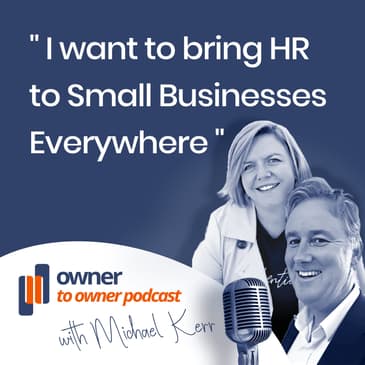
In this conversation, @Michael Kerr and @Amy Christopherson, founder of @Grounded HR, discuss her pathway into small business ownership, the importance of HR in small businesses, and the challenges faced by business owners.
They explore the significance of leadership in employee engagement, navigating difficult conversations, and building a positive workplace culture. Amy shares insights on #exit planning, #employee ownership, and the impact of #remote work on business operations. The discussion emphasizes the need for a growth mindset and the importance of focusing on people within organizations.
Takeaways;
- Amy started Grounded HR while traveling Australia.
- HR should be accessible to small businesses from day one.
- Disengaged employees can sacrifice profit.
- Business owners need to learn people management skills.
- Difficult conversations are acts of kindness.
- Small gestures can build a positive workplace culture.
- Remote work has changed employee expectations.
- Exit planning is crucial for business resilience.
- Employee ownership can be a viable transition strategy.
- A growth mindset is essential for business leaders.
Thanks for listening. Visit the Owner To Owner Podcast website to subscribe, listen back, or check out any resources or information mentioned on the show.
Search @ownertoownerpodcast on your favourite podcast player to subscribe and listen to the episodes.
Reach out to Michael Kerr via the website if you need personal assistance or advice for your small business.
michael.kerr@kerrcapital.com.au
www.ownertoownerpodcast.com.au
Connect with us:
Website: ownertoownerpodcast.com.au
LinkedIn: Connect with Michael Kerr
Share Your Story: Want to be a guest? Apply here.
Disclaimer: The information shared on this podcast is for educational and general information purposes only and does not constitute financial, legal, or professional advice.
[00:00:07] Welcome to the Owner To Owner Podcast. I'm Michael Kerr, your host, and I'm also the founder of Kerr Capital, where for 22 years now I've worked alongside business owners. Owner To Owner is a business podcast to empower the owners of Australia's small and medium enterprises.
[00:00:24] Forget the slick stories of tech titans and unicorns. At Owner To Owner we get raw and we get real. Every Owner To Owner episode is a personal conversation with another business owner just like you. We explore the everyday struggles they face and the different pathways they tread to success.
[00:00:44] Practical advice and plenty of one percenters for better returns, less stress, and more enjoyment. You'll find grit, laughs, maybe a few tears, and some hard-won lessons only available from others who've been where you are, whatever your stage of ownership. Every owner has a compelling story to share, so join us to listen and to learn.
[00:01:19] Welcome into the Owner To Owner Podcast. Amy Christopherson joins me today. A very warm welcome on this chilly day, Amy. Thank you so much for having me. I'm super excited to be here. It is a little fresh. The weather has changed. Yes, you can tell what time it is of the year it is down here in Oz.
[00:01:41] Amy, you're the founder of Grounded HR. I'll get you to talk a little bit about that and your really pretty interesting pathway into small business ownership. What we're going to cover today, though, broadly is a few really important things that you and I are both interested in and I'm sure we'll wax lyrical about them.
[00:02:03] You know, having career changes before settling into one business I think is a really, you know, you bring some broader experience to a small business. Absolutely. We're going to talk about remote work and work on the road because, you know, kind of this business was birthed out there. It was.
[00:02:23] And then we'll touch on your own, not that you're exit planning, I don't think, for an exit anytime soon, but you've got that in the back of your mind and we'll talk about that a little bit. But what about Amy and Grounded HR? Tell us about that. Yeah, so I started the business about four years ago. As you mentioned, I was actually travelling Australia with my family when it was born. I started out in corporate HR.
[00:02:53] I worked in a big business, mining, recruitment, all of those kind of things. And then I actually moved away from HR for a while. I had a complete career change and became an early childhood educator for a while. And I guess that taught me a few, brought me back to a few things that I hold really dear to heart, which are that, you know, people are human. People should be individual. You know, if we were all the same, life would be very, very boring.
[00:03:21] And I then kind of gravitated towards helping friends who were in the small business space. So while I was travelling Australia, COVID had hit and the idea of remote working had become much more accepted, I guess, by so many people.
[00:03:41] And so while I was enduring the wet season in Darwin, I sat around and I planned a business. I decided to move back into the HR space, but do it on my own terms and do it in my most authentic way and not worry about the people around me and how they were doing HR, but try and get my own voice and how I choose to do HR out there into the world.
[00:04:10] So I originally started as Amy Jane HR because, you know, most people start their business with their own name in the title. But about probably about two years ago now, that started to not feel authentic to me anymore. I felt funny introducing myself in that way. And the business had grown to much more than that. By the time I finished my travels, it got serious.
[00:04:39] I actually had people finding me. I had people referring me. And it was time to make this a serious business, I suppose. So that's how the transition to grounded HR about a year ago came about. Okay. It was started with real purpose, by the sounds. But we will get to that. So what is – you operate from not far out of Newcastle in New South Wales. Yeah.
[00:05:09] And grounded HR, what's its – in a simple sense, what does it do? In a simple sense. In a short way, just describe what it does day to day. I want to bring HR to small businesses everywhere. People start a small business because they know what they do in their industry, but they don't necessarily know how to manage people. So I want to bring that to them.
[00:05:37] And small businesses, in most of them, the biggest cost and the biggest challenge probably day to day, I mean, is finding, keeping staff. Absolutely. So you work with other small businesses and you work with businesses right across the country, I think? Yeah, that's right. Yeah. I've got clients in most states.
[00:06:03] I do – I'm collecting a few in my local area now just through local referrals and networking groups and things. But I have clients across most of the eastern seaboard. I haven't got any over in the WA space, but definitely the eastern seaboard. Yeah, okay. And what – when they come to you, what are the challenges they're bringing to you to solve?
[00:06:32] So very rarely are they coming to me in a proactive sense, which I hope that in time that's going to happen. But usually something has gone wrong or someone has told them that it's about to go wrong. So they're either suffering from performance issues within their team, people are disengaging or not performing.
[00:06:55] The business – well, they've had accountants come in and they've questioned how they're paying their people and things like that. So usually they're coming to me with something that's about to go wrong, which is stressful. As a business owner, if you don't know where to ask or who to ask, then that can be so overwhelming. Yeah, it is the sort of stuff that keeps you awake at night if you – because it's so in your face as well.
[00:07:24] You go in to work tomorrow and if there is an underlying issue, some tension, it's right there in front of you. And how does that flow through to the business operations day to day? What's the impact? The data is telling us that if you've got disengaged employees, you're basically sacrificing profit because your people are not performing to their best ability. They aren't on the train, I call it. They're not on the same train as you.
[00:07:54] They're not heading in the same direction. And you actually, as a business owner, have to invite them onto that. So I think that usually you're throwing profits away. You're potentially losing customers because your employees are not treating them with the care and respect that clients should have. And I think that they are carrying a huge weight.
[00:08:19] A business owner is carrying a huge weight when those things are going wrong and they don't know where to turn. So where does the issue lie? Is it a mix between the owner and the employees? I mean, the owner bears a responsibility because they're paying the salary there, foregoing profit or making profit and providing a workplace.
[00:08:48] But, you know, it's a tricky thing, human behaviour. Absolutely. So, but I'd guess it's not always one side or the other. It's a mix of things. But still, you need a delicate or an experienced hand to guide the organisation through that. That's right. And I feel there is absolutely a responsibility on both sides.
[00:09:11] And I've quite often had a conversation with the employee to make them question whether they're in the right place, to question whether they are choosing this job just because it gives them money or are they choosing it because they really love what they do. And so I think when things are not working right, there's a responsibility on both sides. There's a skills piece around business owners learning the skills.
[00:09:38] And that's why I believe that HR should be accessible to small businesses from day dot. They should have access to get their systems, get the foundation set up really well and start learning those skills of how to manage people right from the beginning. But there's also a piece on the employee side where they should, you know, we all need to do inner work.
[00:10:01] I've done heaps in my time because I want to make sure that the business I'm creating, the team I'm creating are aligned and that I'm enjoying what I'm doing because there's no point in having a business if you're not enjoying what you're doing. So I think there's definitely two pieces to that puzzle to make a team work cohesively.
[00:10:20] Yeah, because the e-myth, the book written by Michael Gerber, which has been around for 50 years, fundamentally still, you know, it's a Bible for a lot of small business coaches and owners. And at its heart it kind of says that a lot of businesses are started accidentally by someone who's really good at a trade or a skill or a profession and then it kind of grows around them.
[00:10:49] And recruiting people, dealing with people, managing people isn't necessarily natural for a lot of business owners. But I don't know, when does it, you said that mostly owners come to you when they've got a problem? Yep. They're not complying or the staff are screaming.
[00:11:12] So is that, do you have to go back, I mean, do you have to fix a problem but then go back and say you need to rethink the way you run your business? Is that a part of it? I think it absolutely is part of the conversation. I take it in a gentle way because that's my style. But there's always, there's got to be an underlying issue and you need to kind of drill down, you know, fix what's on fire right now.
[00:11:37] But there's always going to be an underlying issue as to why the fire started in the first place. So I think it's really important to go back to those beginning foundation stages. And that's why whenever I work with a retainer client ongoing, we always start with a HR assessment because I don't want to walk into a business or support a business owner or some employees that I don't actually know how the system's set up currently and where the gaps might be.
[00:12:07] You know, I've worked with clients where on the surface it looks great. They've got values. They've got culture, like defined so well. But then that's never been communicated to the staff. So they wonder why the employees are not performing or not aligned to what they're doing. They've done all this great foundation work but never actually communicated it to them. So, you know, it's finding where those missing pieces are and developing them over time.
[00:12:36] Well, yeah, you wonder sometimes whether there's a burst of energy to, I've got to create a culture. So maybe get a consultant in and, you know, it's good. But it's like a lot of consulting things sit on the shelf. Something more organic, if you can find it, is pretty powerful.
[00:12:58] But, yeah, look, in the hustle and bustle of running a business, it's so easy to look over, look past. But, you know, people are, you know, probably the biggest asset in most businesses, like it or not. Yeah. What are – so you see owners come to you, they've got some challenges.
[00:13:21] What – for owners, you know, running their business day to day, what are some of the things that may not be apparent to them or may not be an issue yet but that might be – ticking time bombs are like a bit of an overstatement but the sort of things that you see owners getting tripped up on because they're not potentially – they don't have a problem yet that they can see. What are some of those things and how do you deal with them?
[00:13:49] So I think some of the things that keep presenting most recently are avoiding difficult conversations. So for me, the saying the standard you walk past is the standard you accept is so prevalent in small businesses because they – the owners seem to like, oh, it's just a once-off. I'll just walk past it and not say anything. And those little things just add up and add up and add up over time. So that's one key thing.
[00:14:18] I think that not having the contractual foundations can be very damaging to your business. If you are not protecting your intellectual property, you're not protecting your confidentiality of your clients, if you are not protecting the interests of your business but on the other side,
[00:14:39] you're not telling the employees what they're entitled to, then there's so much risk associated there with, you know, fair work coming and knocking on your door. The third thing – oh, sorry. Or some key employees walking away with a good part of your business IP or – yeah. Yeah, absolutely. And I think the third one is performance management.
[00:15:03] I think that they don't know how to do it correctly so they prefer not to do it and then they end up with all these employees who are actually damaging their reputation. Because the employees quite often will be happy to take a pay packet if I, you know, I do a half job. Yeah, I put up with it but I've got to pay my bills so it'll do. Yeah, correct.
[00:15:29] So I think they're the three biggest in small business that come to me all the time and sometimes they haven't gone wrong yet and we catch it early enough and other times it's too late. Yeah, look, there's some – they're big three things, aren't they?
[00:15:48] And, look, particularly the loss of key employees or the leakage of commercially sensitive information is a major one. I mean, we put a lot of trust in people but to have it – at least have it clear in a contract or in a letter of employment how these things work.
[00:16:12] And I suppose in some ways that's part of having an organisation where everyone is clear about what they need, what's expected, what happens if things don't go to plan, what's the review process. But, yeah, they're damaging. The cost of finding and replacing staff is high and disruptive.
[00:16:42] The first one you talked about, I'm really particularly interested in those conversations and how do you – I mean, an owner's presented with some problems. You may well be in a position to say it's been a build-up of – this has been a build-up. It hasn't just suddenly happened. That's right. I'm making some assumptions here.
[00:17:07] But I – it's like a lot of things for the – it requires behavioural change or some deep inner perspective on yourself to say, well, I need to be more than an owner, I need to be a leader if it's a very people-heavy type of business. How do you get owners to change their stripes or to act differently?
[00:17:36] I think that – so one idea that I pose all the time is that actually providing feedback or having a hard conversation is actually an act of kindness. You're actually being kind to the person by telling them this information and then giving them the opportunity to change.
[00:17:54] If you are withholding that information, you're actually being detrimental to your own business and there's actually a detrimental personal impact to that person as well. Because there's gossip happening in the background, such and such is not pulling their weight. You know, there's clients or customers who are coming in and saying that this person is doing such and such.
[00:18:19] So by not having that conversation – and that conversation could be something that's really uncomfortable for 15 minutes but will have a long-lasting effect, you know. And it will – it sets expectations. It's all of those kind of things that can really change how someone's engaged in their employment just by choosing to be uncomfortable for 15 minutes. It's – yeah. Yeah. Yeah.
[00:18:47] It's a – it could be quite the step for somebody who's of a particular personality type. Oh, 100%. I think there's an awareness piece there as well. So some people are so ingrained – you know, immersed in the job that they are doing as a business owner and what their to-do list says and all of those kind of things.
[00:19:11] It's like they've got blinkers on and it's not until another employee brings it to their attention that they actually see what's going on. I just recently had a retainer client who was complaining about not feeling connected to his employees and that there was things going on that he didn't know about. And I said, so what are you doing about it? Like are you – where do you go when you first get to work in the morning? He goes, oh, I go to my office and turn my computer on.
[00:19:40] And I went, well, that's the wrong place to be starting your day. And he said, what do you mean? And I said, well, you should be starting your day with your people. You should be putting aside 10 to 15 minutes at the start of your day to walk around – they were in a studio. I said to walk around the studio and have intentional conversations with your people. And so he prioritised that for one whole month between two of our monthly meetings.
[00:20:07] And the difference that he communicated to me one month later from the investment from his people, how open they were now to having conversations with him, the feedback he'd been provided in that time. Like it was just a complete 180. And all he did was prioritise 15 minutes each day he was at work. Yeah. But he also – he or she also listened to some advice. Absolutely.
[00:20:37] To say, you know, you gave that to them and they listened and acted. So it's – yeah, it's a slight change in behaviour or change in pattern. And it's – yeah, you're obviously in the right position to offer that advice to them and they've taken it. So that's – yeah. That's – you know, that's kind of the more organic culture building that I see is more effective.
[00:21:06] Sometimes it's so effective that the owners of businesses that I deal with, it's like, well, it's just normal. This is how it is. I can share and compare because I've – you know, like you work with many, many businesses. And there are many that aren't anywhere close to being cohesive or productive or as – and it's just problem after problem.
[00:21:33] And when you don't have them, it's – you know, they're not that common. But when they are, it's like blissful ignorance because you just don't know how good you've got it. Oh, absolutely. And so many people think, like, why can't I do this? Like, why can't I do this? And it's like, because someone – nobody has taught you how to do it yet. And that's – and it's like not everyone has built into them how to be a leader. Yeah.
[00:21:59] And, you know, some of us are meant to be followers because, you know, we can't all be leaders. But we can lead in different ways too. And we can – yeah, we can be aspiring to be a better leader from whatever level you're at. I think if you're not approaching business leadership with a growth-focused mindset and be willing to change, I said you probably shouldn't be in business. Yeah.
[00:22:27] I mean, yeah, this – I mean, in that sense you mean growth. It's not just about the bottom line or the top line. It's about the harmony of the workplace, the quality of the work that you do, the quality of the employee engagement. That's right. That's what you mean by growth mindset. Growth mindset, I mean a willingness to change things for the better.
[00:22:55] So whether it's change yourself, whether it's change things within the business, whether it's change things for your people, I believe that if you should have an idea of growing and be willing to accept change or make change when change is needed. Hi there. Just a short interruption and a message from Kerr Capital. Kerr Capital specialise in advising business owners who want to get sale ready
[00:23:24] or, as is increasingly common, get approached out of the blue by a potential buyer. If this is you, I know there'll be plenty of big questions and a lot of uncertainty. We're expert at supporting owners in making significant personal and business decisions and then helping create a really strong plan of action. If you want to find out more, contact us at the Kerr Capital website and then we can book a 45-minute no-obligation discovery call.
[00:23:52] Now let's head back to the podcast. The marketplace for employees, how are we now? It's been an incredibly up and down four or five years. Yeah. Complete shifts in the way people work, expectations about.
[00:24:22] But so for your clients, is it easier or harder to find the right kind of employees now as compared to a couple of years ago? I feel like so unemployment's at record lows. So most people are employed. So they're going to be going from one job to another. I think that it's more difficult to find the right employees because so many more business
[00:24:52] owners are becoming aware of how important team fit and social skills are to fitting into a team versus we used to just hire for technical skills. If you said you could do some technical skill, then we would hire somebody. Where now there's so many more things that are taken into consideration in that process. I think that there's also choice out there for employees.
[00:25:16] You know, for some of my clients who have highly sought after skill sets, their employees often have two or three offers on the table that they get to choose from when they start looking. So it's very, very competitive in those highly skilled spaces.
[00:25:38] So the ante's being upped in terms of owners, business owners having to make their place of employment well paid. Appropriate and attractive. Good to work in. Yeah. And all those good things. Absolutely. I keep encouraging my clients that through your social media, through your marketing, through
[00:26:04] however you're communicating with the wider community outside, you are not just communicating with clients. You are actually communicating with future employees. You need to talk to those people as well. You need to communicate your values. You need to communicate what you're about. You need to communicate all of those kind of things so that people start getting buy-in. That'd be a place I'd want to work. Okay. Yeah.
[00:26:31] So that's stuff you do every day that you become an employer of choice. Correct. Of choice is probably the right term. Yeah. Okay. What industries do you span? Like you're working... A lot. Yeah. Okay. So what you're talking about is based on a pretty diverse range of industries. Absolutely.
[00:26:56] We're talking civil construction, tiling, art therapy, NDIS, environmental scientists, tech software companies, car washes. I'm working with like a huge variety of clients across many, many industries and many states and these are the things that are happening for all of them. Yeah. Okay. So it really is...
[00:27:25] If once upon a time big corporate employers were making like the campus and free lunches and the gym and the whatever, now it's on... And it's been done by lots of... I've met plenty of owners that have created a really good culture and environment. People are happy there. They stay there and... But it's... That sounds like a real... Not only a competitive...
[00:27:53] It's a competitive edge but also a necessity by the sounds to just... To be in a position to employ the right people, you have to up your game a bit. Yeah. And it's about the small stuff. Like we don't... Like small businesses can't do the gym memberships and the... You know, all those really big ticket items but... A masseuse and, you know, in-house and... How nice would that be? But we're talking about small stuff.
[00:28:23] Giving them a little bit of flexibility so that your employee can go to the school's assembly. We're talking about a thank you note put on their computer because there was a really good client feedback. Giving them a small coffee voucher or taking them for a coffee so you can have a conversation and thank them in person, you know. It's really simple daily stuff that can create that evolving amazing culture within a business. It doesn't have to be big ticket items.
[00:28:51] We're not talking about huge bonuses at the end of financial year. We're not talking about any of those kind of things. We're talking about the small acts of thanks on a daily basis. Yeah. Yeah. Okay. Okay. I've been really keen to talk about the birthing of Grounded HR. It sounded like it was in Darwin but tell us about... You were doing a lab? Yeah.
[00:29:18] So we decided to pack up and take our kids around Australia. We initially committed to about 12 months and after 12 months we were so not done. So we decided to continue. We packed up our home and rented it out and then continued to travel with no fixed end date. So then COVID hit. We ended up being stuck in the Northern Territory for close to two years but we travelled around
[00:29:47] and worked and did different things while we were up there. Some of that time in Alice Springs which was an interesting experience both for our children and for us. Yeah. And then we moved to Darwin and worked and lived in Darwin for a period of time as well. But we pretty much did everywhere except for Queensland. So we went to Tassie and then up through the centre and then around through WA in South Australia.
[00:30:15] So across the four years we learnt so much. The kids now, I think they're still learning what they were able to experience compared to their peers. And during that time I got the urge to start a business. So that's what I did. Yeah, I suppose there's quite a few factors that go into that moment where you decide you're going to do that.
[00:30:41] But part of it is being free of the constraints of the day-to-day. Were you working as you were going anyway? Like you and your husband, you needed to make some money. So what were you doing HR? I was doing early childhood actually. So I started the travels. So my husband had long service leave. So we lived off that for a little while. Then we worked down in Melbourne for a little while.
[00:31:12] Basically wherever we walked into, because he's got a trade, there was always work available. So people would be happy to just say, oh yeah, how long are you here for? Seven weeks? Perfect. We'll put you on for seven weeks. We've got work for you to do. So that's kind of how it happened. And my husband ended up moving into cranes. So he worked for the local crane company in Alice Springs and then another guy in Darwin.
[00:31:40] And I worked at a local preschool in Alice Springs. Okay, so yeah, there's a couple of things here that are really deeply interesting. One is that you take this big trip and you kind of find your way. And that's part of a real proper journey, isn't it? Wherever you land, you do what you need to get going. But also this...
[00:32:14] I was really deeply interested in this... What I call the circular economy, which is this group of... I don't know how big it is or... We did a trip across the Nullarbor 18 months ago and bumped into, talked to lots of people who were doing the lap and were doing odd jobs here and there. Some were actually...
[00:32:42] It wasn't landing somewhere and getting a job. They were taking their job with them. Hairdressers or... So many. Lots of service, tech-based people and in this, you know, travelling circular economy where... Yeah. You know, I'm guessing it's hundreds of thousands of, you know, caravans and people and camp trailers at a time, you know, and it's a really fascinating thing. As what the...
[00:33:11] And I want to talk about exit planning, but I've had a few interviews over the years where I've had somebody come in and talk about just taking... Getting their business ready so that they could step away. It was under management. They could go do some things that they desperately want to do with their kids. Come back and the business was still... Absolutely. ...there and functioning. And they learned an awful lot about, you know, how robust they needed to make the business and the team.
[00:33:40] And then there was somebody else who came in, you talked about taking their retirement in installments. Like, it's a really cool concept. It's like, you know, I'm going to take a full... I'm going to take a longer break because the pattern can be work hard, work hard, work hard again. Don't take this. Don't take that. And 20 years or a bunch of time goes by and you go, my business is okay, but I haven't
[00:34:09] really done terribly much else. And I'm a bit, you know... Absolutely. I'm missing out. I'm a huge advocate for taking breaks from your business, whether they're small or large, because I feel like you get clarity in those moments. But I also, for us, travelling while we were younger, but also while our children were old enough to remember it, was so important to us because I have seen...
[00:34:35] When I worked in mining, I had so many gentlemen who retired from their job. They'd worked shift work for 50 years and within a month or two, they had passed away. And it was so, so common. It scared the life out of me that one day we would work ourselves into the ground and never actually get to enjoy the fruits of all our labour.
[00:35:01] So I think that with how busy, fast-paced life is these days, more importantly than ever, we need to be taking these breaks. And this is one of the ways we can do it, right? Is packing up and travelling and working as we do. So many... I met so many people on the road that their employer let them take their normal job with them. They were accountants or bookkeepers or, you know, all of those kind of jobs that they
[00:35:29] can do from a computer that, you know, it never would have been considered before COVID, right? That all of these kinds of jobs could be done through travel. And, you know, I ran a business and homeschooled my children and still had a really good travel life. Yeah. Yeah. Yeah. It's... Yeah. And here you are.
[00:35:52] Like, and that business grounded HR has been birthed, you know, from whilst on the road and whilst really probably clear about what you wanted to do with it. And sometimes, you know, that time and space, you know, enables that. And being as contrasted with just doing the do day in, day out and then those horrible
[00:36:20] examples that you talk about when, you know, it's like, I'll get there, I'll do some of that when I'm... Yeah. You know, do it now. In instalments or... Or building your business so that it's... It's not possible in all businesses, but it's possible in some. Where you can get it to a stage where with the right team, you can take...
[00:36:45] And it might not be six months or a trip around Australia on the circular... In the circular economy. It might be just taking four weeks or six weeks, going away somewhere. That's right. And not letting it fall over, but just, you know, you've got to maybe build towards where you can take longer periods of time. Absolutely. And I think you need to also build it. So in my circumstance, my mum is ill.
[00:37:12] And so I have had to build it into my business that I'm able to step away at any moment. And my team know, although I'm the main HR consultant within the business, there are backup plans in place around who does what and who's going to take over what and all of those kind of things. So I think we, whether it be a stepping away to take a holiday or stepping away for necessity,
[00:37:40] you would be not planning your business very well if you hadn't put that plan in place. So I think, you know, you need to have, even when you are a solo person in a business, you need to have some kind of plan for how that's going to be handled if you have to step away in any instant. Yeah, this is the conundrum for me that there's a lot of businesses that aren't ready to sell tomorrow.
[00:38:09] And the solution is to do some exit planning. So I'm all, I agree, there's a lot of businesses that aren't sellable that could be. They need some exit planning, some sale preparation. And there's resistance because it costs money or it takes time or, you know, I just want to sell tomorrow. The real opportunity lost is, yes, putting 40 years into your business and then going, oh,
[00:38:37] you know, I'm not so well or I can't enjoy or I can't actually get out of my business. So the real advantage in doing, if you call it exit planning or sale readiness planning, is that you do make your business, if you take it out to its logical extreme, it's you make your business sellable.
[00:39:00] But in the same breath, you make it, if it's sellable, it's also, you can keep owning it with less of your time. Right, that's right. And this is where it creates the, so the term is linked very much to, I own it today, I'm going to exit plan, I'm going to sell for X dollars or whatever in three years time. Okay, great. If that's your plan, excellent.
[00:39:28] The opportunity missed is to link exit planning just to the outcome being a sale. The thinking should be, what are the good pieces of that exit planning, sale readiness that will make my business able to stand and work without me there 40 hours a week? I might be able to cut back to 20 or I might be able to take an installment on my retirement,
[00:39:57] go away for six weeks or take a longer trip. That's what I, so when, and that's the work I do day to day, you know, getting owners to think about that. But so tell me about your, your exit, you talk, I think we both called it exit planning, but you were thinking ahead. So what have you, what's your motivation? What have you started to do and why?
[00:40:21] I feel like, uh, I'm still in a little bit of a, um, place where I'm deciding whether I'm going to grow bigger or, um, I'm happy where I'm at. Uh, I have teenage children, so I know that my next five to seven years is going to change dramatically. I'm going to go from having children who are reliant on me to ones who are out there in the big wide world.
[00:40:44] So I guess I've not pressured myself into that decision yet around whether I am in for the long haul or whether it's something that I will look to, to sell later. But I feel like my, I, I get so much enjoyment from what I do that I would find it very, very difficult to walk, just sell it and walk away. I feel like I've got friends who have bought into businesses because, and, and it's kind
[00:41:14] of been a transition over time where they've just slowly stepped back and stepped back. And then my friends have bought in and bought into a business. And I think if you bought, if you've built a team that are really invested in the vision of the business, then they should be the first people you're starting to talk to about that transition process, about whether they're willing to invest in. Yeah, employees. Are these employees so invested in the vision of the business that they would invest and
[00:41:43] become part owners in the business? And I think that, that, that if you've created something that is of so much value and that you created the vision so clearly, then it should be easy for other people to want to continue that vision. Yeah. Couldn't agree more. There's, there's, there's so much, there's a lot of businesses where the most natural
[00:42:15] owner, there's two types of natural owners. One is a competitor or someone else in the supply chain. And that's, the other is, is employees. I, my, I think it's, I think it's the long game, as you say, to firstly build a business that is, performs well and has all the right.
[00:42:41] But you know, if you bring in the team or senior members of the team over time and, and they're business minded, I mean, it, the opportunity for them to invest in something that they know so much about is, is, is really interesting. It's, it's not, they know how it works. So I mean, there's the big step up between being or from being a really good manager or leader
[00:43:10] or whatever to being an owner because there's... Huge learning curve. You wear different hats. Huge learning curve. But, but, but with, but with, you know, with time, like you've got to believe that that's, that's, that's very doable. It's, it's probably, it's on the owner and it's also on the employees. Generally, I think it's a really, it's a real, it's so much focus on wealth creation through managed investments and property and through business. It's real.
[00:43:40] And as a, you know, you talk about risks and there's risks in all those things, but if you've been working in a place and you, you understand, you're, you're, you have a job that you're good at, that you enjoy, see you deliver good outcome services and you know the, you know the clients, you know the operation system, like you're de-risking it quite a bit as an investment.
[00:44:07] And if you're not, particularly if you're not, you know, if you're buying with a few people. Yeah, that's exactly right. Yeah. And you've got the good and the bad, right? Because you can see the, the, you can see the challenges within the business, but you can also see the positives from being on the inside. Yeah. Yeah. The, the, the, the opportunities around employee ownership and the, the energy around that's real.
[00:44:33] I've, I've, I'm involved in a couple of, um, as a working group on employee ownership. I, my last interview was with Anna Northam who has this, um, sourdough bakery in Bermagui. Like 60, 60 staff. Wow. That's a huge bakery. Which is a big employer. Yeah. In a, in a, you know, in the, in, I'm guessing that's probably one of the outs, I don't know
[00:45:01] what the makeup of the Bermagui economy is, but that is a big small business. Very much. Small business. So from, from the point of view of transitioning successfully 60 jobs, employee ownership is got to be, and, and so they're exploring, uh, employee ownership trusts. So there are, you know, there's a few different mechanisms.
[00:45:24] I, my experience is mainly with just, uh, a couple of owners or a team of owners become direct shareholders in the company that owns the business, right? It's, it's, um, uh, you know, there, so there are different models emerging, but the, you know, they're the, basically the, um, the energy is, um, is enormous around employee ownership and the opportunities and upside are very real.
[00:45:52] Um, but a lot of education needed on both sides for owners to, how do you, how do you have that delicate dance with employees? When do you start it? And then for employees to kind of get into the mode of thinking like owner and employee, an employee. No, that's exactly right. Exactly right.
[00:46:18] So, so for you, um, you, you're, you see, uh, we'll call it exit planning. Um, it, it, you're, sounds like you've, you want to build in a bit of resilience and robustness to the business, give you some, you've got a, uh, a period of time where you, you know, there's, you won't be doing a, a, another lap in the near, in the near term because you've got teenagers.
[00:46:43] And, but maybe at the end of that, that's, um, the effort you make to make the business ready. Um, is a, is a good investment. Yeah, absolutely. I think that my husband and I have not done a lot of overseas travel. We made the choice to travel Australia with our children and then, um, want to travel overseas when it's just the two of us. So I think that that's going to be the eventual plan is that the business can travel with me
[00:47:08] when I want to, or when I want it to work and that, um, that I will be able to have a small team potentially that can, you know, keep everything rolling. Yeah. Yeah. So that, that is, um, I call it exit planning again, that, that driving towards a sale of the business at a point in the future is not the sort of, that's not the, the, the absolute focus. It's about flexibility.
[00:47:37] So all the things you do to make it sellable also make it holdable. That's exactly right. Exactly right. I started for flexibility. I started traveling. It was now it's for my children and for my parents, uh, to be able to have that, to be able to have that flexibility. And then, you know, later it'll be for that flexibility for enjoyment. Yeah. Yeah. And, um, yeah, possibly bring on some team. All right. Um, thank you for that.
[00:48:05] Like it's, um, we want, you know, we want every owner to, to have thought about that, um, and done something about it. What's some, uh, books and people, blogs that you, uh, just a couple that you, um, you draw inspiration from could be a local business, could be an international guru. Yeah. So I'm a huge Mel Robbins fan. Um, her most recent book, the let them theory was something that really resonated with me
[00:48:34] in, um, me stepping into my own voice authentically and, and showing up as myself and my style of HR, you know, um, let all the other HR consultants do what they want to do. Um, but also let me be me and, and, and put my voice out there. Um, so that was a big one for me. Um, my business coach, um, has been a huge inspiration as well. Um, Christine Corcoran, she has just written a book, um, on imposter syndrome and the work
[00:49:03] that I've done with her mindset work, uh, and the sales work because sales didn't come naturally to me. I might know how to manage people, but selling, uh, what the outcome that I can deliver, um, was not something that I, uh, knew how to do. So those two people have been huge influences in my business career over the last 12 to 18 months, probably. Yeah. Look, if you, yeah, you, at various points through this conversation that we, we talked
[00:49:32] about recognizing when you need some counsel or some advice or some support and actually then, you know, taking it. So yeah, good, like a good, um, a good business coach that, um, you know, we have the other trusted advisors to do your financials and things, but someone who can connect the dots for you as well as in your business is really valuable. All right.
[00:49:57] So Amy Christofferson was, um, I don't know, elected or appointed as the head of Australia's small business department. What are you, what are you going to like day one up there in Canberra? What are you going to, what are you going to get the, the team up there to focus on to make our Australian small business economy more viable and more resilient? We need to focus on people. We need to have those foundations from the beginning.
[00:50:25] So every small business should have access to great advice, to be able to set up their people systems and create those foundations, as well as that there should be skill building. There should be skill building available for small business owners to make sure that they can build the skills to be a really good leader and therefore create a really good culture and team within their business. So I think that creating those foundational and whether that is, you know, the paperwork stuff,
[00:50:54] but also the business stuff, I think there, there should be more support for that. You know, so a huge percentage of the businesses in Australia are small businesses and most of them are family run businesses as well. So we're talking about husband and wives or partners or family members who are running businesses together. And that can create tension.
[00:51:19] So we need to make sure that we're doing this people related stuff well to reduce that tension so that they can go home at night and still be really good people outside of the business, not just 100% focused on business as well. Yeah. Yeah. Yeah. Okay. Yeah. If we, if we could get a part of that right would be, you know, the most businesses would be so much better off.
[00:51:42] It's like just being able to remove yourself from your role in the business as, as you said, as an owner to being, to take you on that you're a leader as well. And, and, and, and for employees aspiring to be, particularly if they're aspiring to be co-owners or owners of businesses, be a good employee, but, you know, learn out, learn how, train up,
[00:52:12] talk to other, you know, talk to owners about what it's like, you know, beyond just being a really good employee. Yeah. That's huge. Uh, there's, we could bridge a lot of, um, or, you know, get a lot of opportunities realized if, um, you know, if we can get those couple of things. A hundred percent. A hundred percent. Humming. All right, Amy, that was, um, I, uh, love the story of how this thing was. Born. Was, uh. Yeah. Started. Yeah.
[00:52:42] And why it was born and, and, and, and the purposeful way you're going about it. So congratulations. And I wish you well with. Thank you so much. Thank you so much. All right. Well, look, um, we'll, uh, I'll put your, um, details in the show notes. Um, I'm assuming you're happy for potential clients to reach out. I would love to meet some new people. So yes. And I always offer a free chat because I'm all about us being aligned as well.
[00:53:10] You know, you, you, the people you trust to bring into your business, you need to work really well with them. So always up for a chat. Starts with a, uh, uh, yeah. Like a coffee meeting or a virtual coffee meeting. Absolutely. A good chat. All right. Um, well, again, thank you. Take care and, um, go well. So thank you very much for listening.
[00:53:40] I hope you enjoyed this episode of owner to owner and got some helpful advice and maybe some more clarity on how to make your business work better for you to subscribe or to listen back or to access any of the resources or information we talked about in this episode. Head over to the website, owner to owner podcast.com.au or you can search up owner to owner podcast on your favorite pod player.
[00:54:07] If this episode or the podcast generally is really helpful, I'd love it if you could leave me a like, a rating or review, but even more than that, I'd love it if you could share it with another business owner. There's a new episode out every couple of weeks. I'll catch you then.